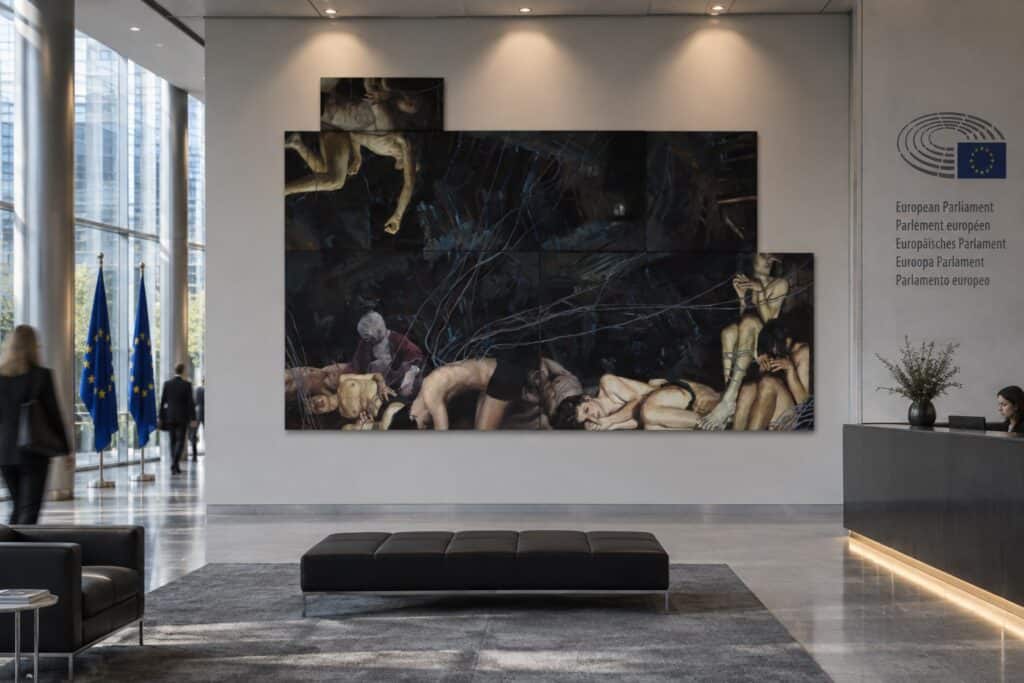
Birds is most compelling not as a single political allegory, but as a total system in which the body, space, control and dehumanisation are inseparably bound together.
What might this mean?
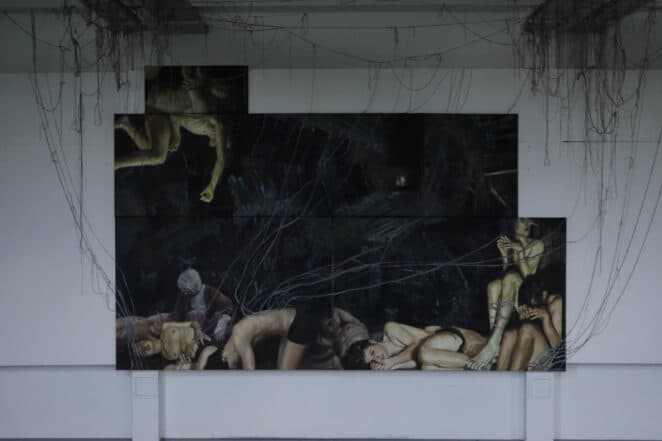
The first paradox lies already in the title. Birds would seem to promise something light, mobile and free. At the same time, it inevitably summons the association with Alfred Hitchcock’s film The Birds. There, birds are not simply animals but a collective, inexplicable and uncontrollable threat — their force lying not in the individual but in the mass. In Grigorjeva’s painting, too, the bird-people register less as distinct beings than as a condition: people who have imperceptibly become something else.
This naturally recalls Hieronymus Bosch, whose human-bird hybrids symbolise moral disorder, sin or punishment. Grigorjeva employs the same figure in an entirely different register. Her bird-people belong not to a religious world but to a political system. Hybridity here does not read as punishment but as a state that the individual has arrived at under the system’s pressure. In this sense, the transformation into a bird can be read as a metaphor for dehumanisation.
Space as an active force
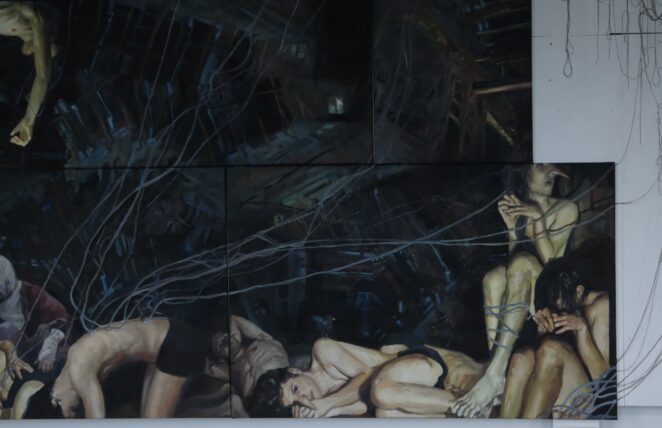
Space is as important as the figures themselves. The people do not fill the picture; they are pressed into its lower edge. Above them opens a vast dark space, where the empty surface functions not as a neutral backdrop but as an active force. There are isolated openings, edges and architectural hints, yet the space never becomes fully legible — recalling by turns an industrial building, a bunker, a server farm, or subterranean infrastructure. It is precisely this indeterminacy that makes it threatening: the individual no longer controls the space — the space controls the individual.
Art-historical connections
This draws a parallel with Giovanni Battista Piranesi’s imaginary Carceri prisons, in which the human figure is always dwarfed by architecture. Space grows beyond it, becoming an endless and barely comprehensible system. Grigorjeva does not cite Piranesi formally, but the psychological logic is the same — architecture is not merely a setting, but a vessel of power.
The work’s fragmentary construction deepens this feeling. Perspectives fail to meet, light does not carry from one panel to the next, and the different spaces seem to belong to separate realities. The world reads as though it had come apart at the seams. In today’s information environment, control no longer operates through a single grand narrative, but through fragmented images, contradictory information flows and parallel realities.
The invisible network
This feeling is reinforced by cords or wires descending from the ceiling. They function at once as an element reminiscent of installation art and as part of the depicted world. They can be read as electrical wiring, a nervous network, internet cables, a propaganda network, or a medical monitoring system. On one figure’s back, they attach almost like hospital monitoring equipment. The monitoring of vital signs becomes here a metaphor for social control — a system whose mechanism remains invisible to the individual, yet whose effect on their behaviour is entirely real.
The body as object
The two uppermost figures, too, deliberately violate ordinary spatial logic. They are neither fully grounded nor fully airborne, but exist in an in-between state. They may recall the floating bodies of Baroque ceiling paintings, but in Grigorjeva’s world there is no redemption or transcendence to be found. Even the sky offers no way out.
Particular attention is warranted by a mummy-like figure with a bird perched on its head. The human body is almost entirely wrapped, rendered into an object. The bird, which would normally symbolise life or freedom, functions here instead as a guard, a marker, or a bearer of power — suggesting silence, control, or the loss of human agency.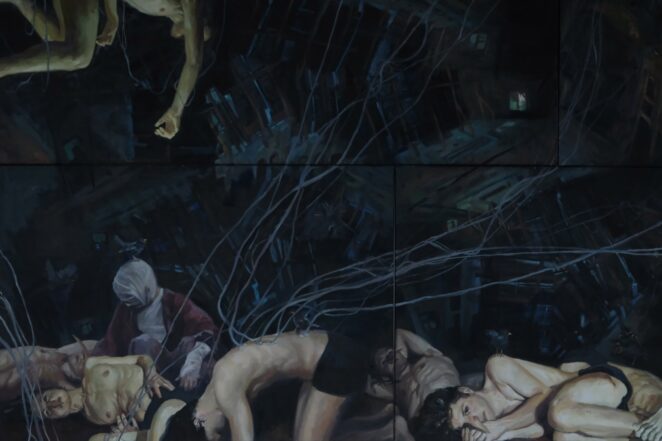
The system is larger
Most of the figures are horizontal and passive. They do not drive events but appear subject to them. Yet they do not form the dense mass of bodies typical of a traditional scene of suffering. On the contrary — a great deal of emptiness surrounds them, which makes the whole situation even lonelier.
The work’s dark atmosphere inevitably recalls the Polish artist Zdzisław Beksiński, whose anonymous bodies, sense of unexplained catastrophe and monumental emptiness produce a similarly nightmarish effect. Unlike Beksiński’s surrealist worlds, however, Grigorjeva’s treatment is distinctly political. Her horror is born not of fantasy, but of the recognition that invisible systems can shape human behaviour just as effectively as direct violence.
Bird beaks, wires, a fractured perspective, anonymous bodies and a monumental architectural space together form a world in which the individual is no longer the centre. Space is larger. The network is larger. The system is larger.
And perhaps this is where Birds‘s strongest message lies — control no longer manifests solely as visible force, but as an environment in which the individual imperceptibly learns to live.