Among the artists participating in Embodied Thought is Edgar Jerins, who teaches drawing at the New York Academy of Art and has also given guest lectures in Latvia. His connection to the country is personal as well as professional. Both of his parents, Rita Jēriņš and Gunars Jerins, were born in Latvia and left the country as child refugees, eventually settling in the United States.
Jerins is known for monumental charcoal drawings depicting his family and people from the American Midwest. Through intimate scenes, his work addresses addiction, mental health struggles, violence, loss, economic insecurity and family relationships, combining close observation with the social pressures shaping his subjects’ lives.
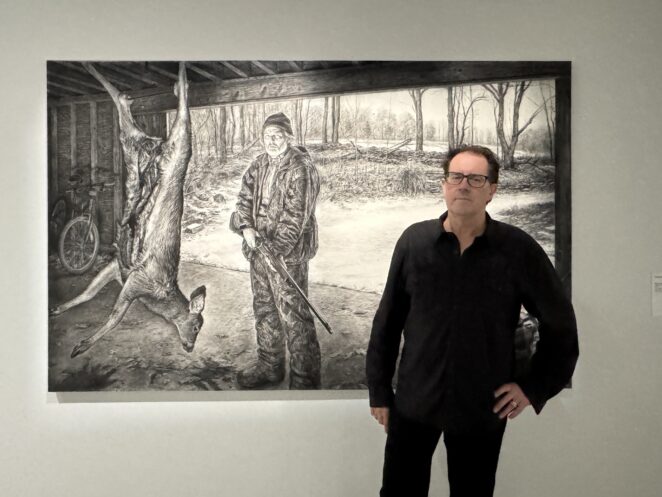
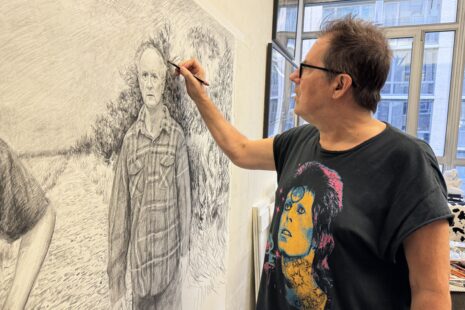
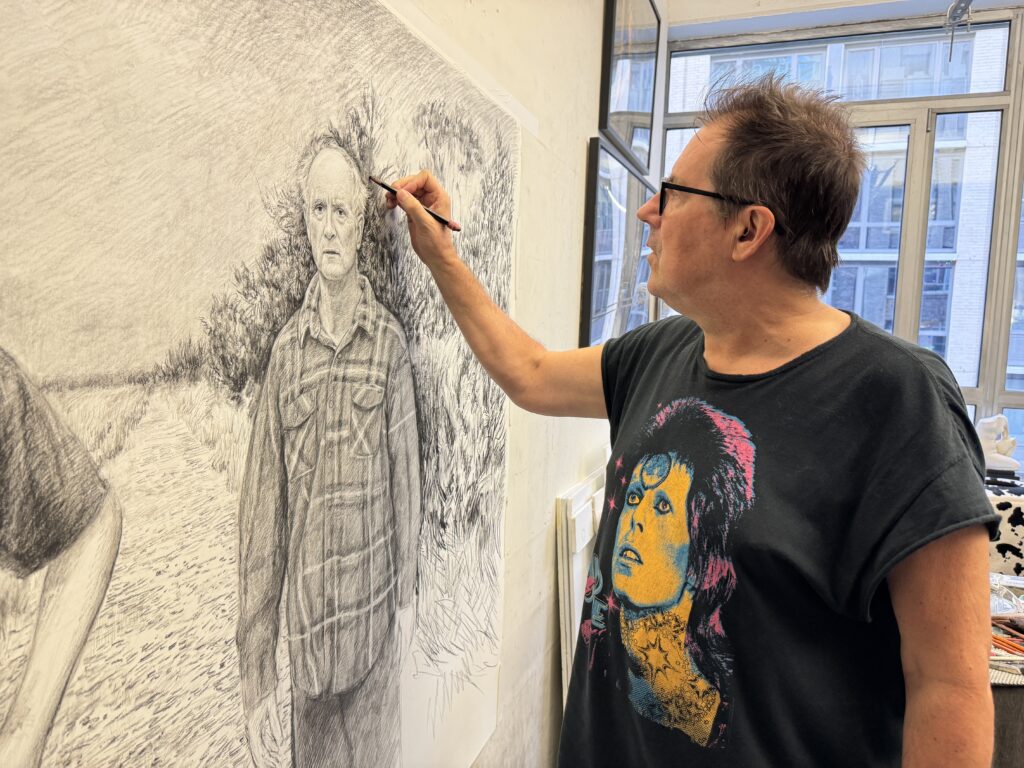
Edgar Jerins in front of his work at the exhibition “Embodied Thought. Drawing in Latvia. 18th–21st Century” at the Latvian National Museum of Art in Riga, 2026.
Jerins studied at the Pennsylvania Academy of the Fine Arts from 1976 to 1980, receiving an education rooted in the school’s long tradition of working from the human figure. His work is held in collections including the Minneapolis Institute of Art, the Museum of Nebraska Art and the Latvian National Museum of Art, while his 2023 monograph, Life in Charcoal, brings together the large-scale drawings he began in 2001.
Today, Jerins teaches drawing at the New York Academy of Art. In 1982, Andy Warhol joined the artists, scholars and patrons who founded the school to revive training in figurative and representational art. More than four decades later, the relationship between technical ability and contemporary artistic thinking remains central to its mission.
Our conversation begins with the wider social atmosphere in the United States and Latvia before turning to Jerins’s own work, the role of drawing and technical skill, and what young artists are learning today. Jerins is unequivocal about the value of skill, but equally direct about the realities surrounding an artistic career: money buys time to work, professional relationships matter, and reputation can shape how seriously an artist is taken. From there, the conversation opens onto a larger question of power in the art world—who determines which artists gain visibility, whose judgement carries weight, and ultimately, who contemporary art is for.
From outside, the United States appears deeply divided. Is that how it feels from inside? Where do you notice it most in your own daily life—in the classroom, in the art world, or when you go back to the Midwest?
Yes, I would say that the United States is extremely divided, and there is a level of political volatility that I’ve never seen as an adult. The closest comparison would be when I was quite young, during the Vietnam War.
It has created an unnecessary level of hostility between people, where ideas cannot be discussed without going to extremes. It’s best just to keep one’s political views to oneself unless the person you’re talking to is in agreement.
New York’s universities and arts institutions have been under visible political pressure, from campus protest disputes to the 2025 cuts to federal arts grants. Have you noticed a change in what your students feel able to say or make work about? Are they more outspoken, more cautious, or simply concerned with different things?
Please keep in mind that I’ve only been part of academia since 2010, and that has been as an adjunct at the New York Academy of Art. So my knowledge of college campuses and student ideas is quite limited. The New York Academy of Art is an MFA program, and I would say that the majority of the work is of a personal nature. I don’t think students would be disinclined to explore their political ideologies in their artwork.
I myself don’t discuss politics with my students. I certainly discuss artwork and ideas, and the art world to some degree.
Both of your parents left Latvia as child refugees. Today Latvia borders Russia and Belarus and lives with the war in Ukraine close at hand. During your time in Latvia, have you noticed a different way of speaking about the future, uncertainty, or responsibility to others?
The trip has been three weeks and has primarily been concerned with discussing artwork, so I can’t really respond to this question in much depth, as I haven’t talked a lot about politics. I know there is a focus on Ukraine that is much more intense than in the United States, due to Latvia’s physical proximity to Russia.
In the United States, an artist’s livelihood usually rests on gallery sales, teaching, and private patrons; in Latvia, far more depends on public funding such as the State Culture Capital Foundation and on a small domestic market. How do money and security come up differently when you talk with artists in the two countries? Does either system make certain kinds of work easier or harder to make?
My exposure to public funding is limited, but when the United States had individual grants from the National Endowment for the Arts, I applied every year, basically knowing that I would not receive a grant because these grants were given to artwork that was fashionable at the time and not to representational artists. This didn’t endear me to the public funding of individual artists. It felt like an insiders’ game. Who will the government get to judge the awards but the people who are selling and promoting the latest styles?
A creative career of any kind is extremely difficult. I don’t think security is part of it unless you’re a full-time instructor. But even then, many art schools across the country are now going under.
When you draw people close to you, how do you decide how much of their story belongs in public? Has anyone you have drawn ever been upset by the way you portrayed them or by what you revealed? What kind of feedback have you received from your subjects and their families—and from the audience?
With my narrative charcoal drawings, I try to show as much as possible about my subjects’ lives—to show their vulnerability and tell their stories. I’ve only been turned down by a few people when I’ve asked them to be subjects, and that’s fine, of course. But I draw people who never expected to be in a work of art. In the end, I think people feel honored to have their stories told. I’ve found that even with the darkest subjects, the families and friends of the people in my drawings are thrilled with the final artwork.
I do get this question from people outside, because I portray difficult moments in people’s lives. People wonder how the subjects feel, and I think they appreciate having their stories told honestly and truthfully.
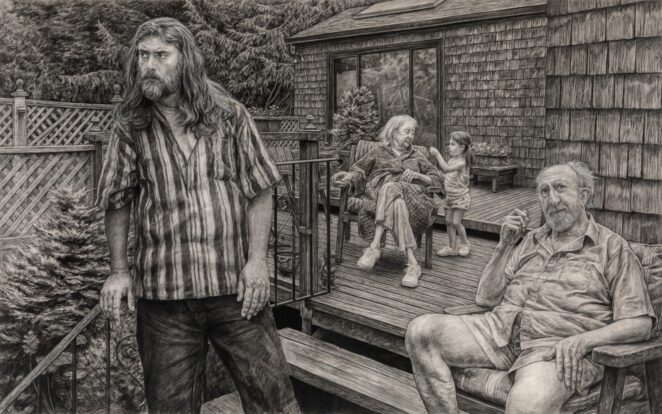
Edgar Jerins, The Andersons On Their Deck In Garden City, 2005. Charcoal on paper, 60 × 96 cm.
You work in charcoal at a monumental scale with subjects that might once have belonged primarily to documentary photography. What can a drawing say about these lives that a photograph cannot?
Photography has taken the primary role in documenting contemporary life, but photography, painting, and drawing are very different art forms. The perception that photography made representational art irrelevant hasn’t panned out. Representational artwork, when done well, is filtered through the artist’s sensibilities, adding something very different to the final image.
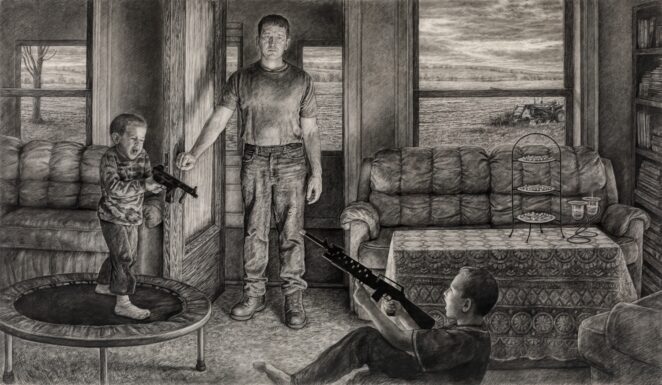
Edgar Jerins, *Christmas Day. Yutan. Nebraska*, 2004. Charcoal on paper, 60 × 103 cm.
Could you take us through the making of one large drawing, from the first encounter with the subject to the finished work? Where do direct observation, photographs, memory and invention each enter the process?
When I begin thinking about the next drawing, it starts with an idea. And that idea comes from what is happening in my subject’s life, or in the lives of my subjects. I then do a series of photo shoots, with the first ones being very casual. I use my camera as a sketchbook, placing my subject in different parts of the house or apartment—standing, sitting, lying down—and trying out different lighting, generally with a single light source, such as a clamp light.
After each photo session, I review the images, and it’s mostly a process of elimination. Often, I don’t find anything in the first photo shoot, but I might notice something that begins to suggest a drawing. In one case, the children picked up the toy guns they had received for Christmas; in another, it might be a shadow on the wall. Something like that can move me towards a more fully formed image.
There are times when I go through a whole series of photo shoots with compelling subject matter, really interesting settings and good backgrounds, and I still can’t get what I want. Then, of course, I don’t begin the drawing.
But if I find the right arrangement, I begin to narrow it down. Let’s say it’s a multiple-figure image: I get everyone together so that the lighting is cohesive and the scale of the figures works, and then I take a lot of detailed photographs. I’ve never really worked from memory. I need a reference, whether it’s photographs or, better yet, working from life.
Most of the work on a drawing is done using photographs, but I will work from life with my subjects whenever possible. It gives me so much more information, much more quickly.
I feel I’m able to work from photographs because of my training—learning how to draw and paint the figure from life.
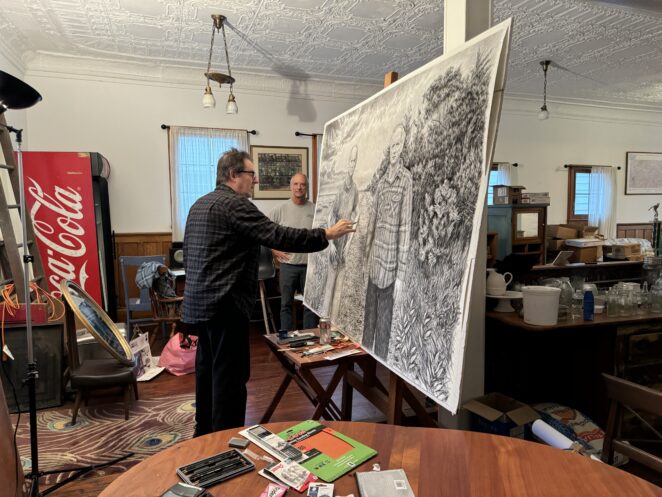
What makes a drawing contemporary in its thinking, rather than simply recent in its date?
This was something we discussed quite often at the Pennsylvania Academy of the Fine Arts, the art school I attended from the ages of 18 to 22. The training was based on working from life and from the figure, so there was a lot of representational artwork being made, particularly by older students developing their own work in their third and fourth years.
One of the instructors, who was very traditional in his approach, said: “Since you are alive now, your work cannot be anything but contemporary. Even if you are using Old Master techniques or their subject matter, your sensibilities and the way you think are contemporary and different from how people felt and thought in the past.”
You trained at the Pennsylvania Academy of the Fine Arts and now teach at the New York Academy of Art. Which exercise or skill from your own education still proves indispensable, and which part of that training have you had to question?
I feel very strongly about this, and I think that an artist’s training should initially focus on drawing, painting, and sculpting the human figure from life, continuing a 500-year tradition. The thinking is that if you can draw and paint the human figure, you can draw and paint anything. I think that art schools that don’t make working from life and from the figure a central focus are a waste of time and money and do not serve their students well.
I have found that there is an assumption among many instructors that students already have a grasp of technical issues—specifically, how to lay out a palette, which brushes to use, which mediums to work with, and which colors of oil paint to put on the palette. But many of them don’t. So it is important to teach these basics. This was a problem at the Pennsylvania Academy of the Fine Arts, and it is a problem at most of the art schools where I have lectured.
I have many friends who complain that art schools don’t prepare students for the actual business of art. The advice I would give—and have given—to students is to get to know their fellow students, make friends, and build as many contacts as they can while they are in art school. Much of your career will depend on who you know.
And have a good relationship with money. Specifically, be very careful with it. Money gives you time at the easel.
What do you insist your students learn today? Could you describe one assignment? And if you could change one thing in art-school curricula, what would a graduating student then be able to do?
The class I teach is narrative drawing, so the main assignment is to find a compelling or interesting narrative and then be able to tell that narrative visually. It doesn’t have to be something obvious—or, as one instructor said, “Don’t make a federal case out of it.” I think a great work of art has depth and mystery, so it is an intriguing balance between telling a narrative and perhaps not being too obvious about it.
The simple answer regarding graduating students is that they should begin making their own work, rather than exercises and studies.
Andy Warhol was among the founders of the New York Academy of Art. What does his involvement reveal about the relationship between artistic experimentation and traditional training? Does that founding ambition still shape what happens in the classroom?
From what I understand, Andy Warhol felt that artistic training was drifting too far away from traditional training and that all artists should know how to draw. This is achieved by drawing the figure and studying anatomy. That remains at the fundamental core of the two years of study at the New York Academy of Art, particularly the first year.
I also think it is a great benefit to the school to have had Andy Warhol’s involvement and blessing from the beginning.
At the Art Academy of Latvia I’m repeatedly struck by how seriously students are still trained in drawing and painting technique—proportion, anatomy, observation, material control. Looking at the student work here, is there anything you think American students are generally trained to do less rigorously? And conversely, what are American schools asking of students that you see less of here?
In the two and a half weeks that I’ve been teaching at the Art Academy of Latvia, I’ve felt right at home. This is the training I had, and it is also the training given to students at the New York Academy of Art.
The figure is the Mount Everest of drawing—it is very difficult—so it is the best barometer of how well someone can draw. I would say the training here is very similar to that at the New York Academy. And I’ve seen a lot of talent here in Latvia!
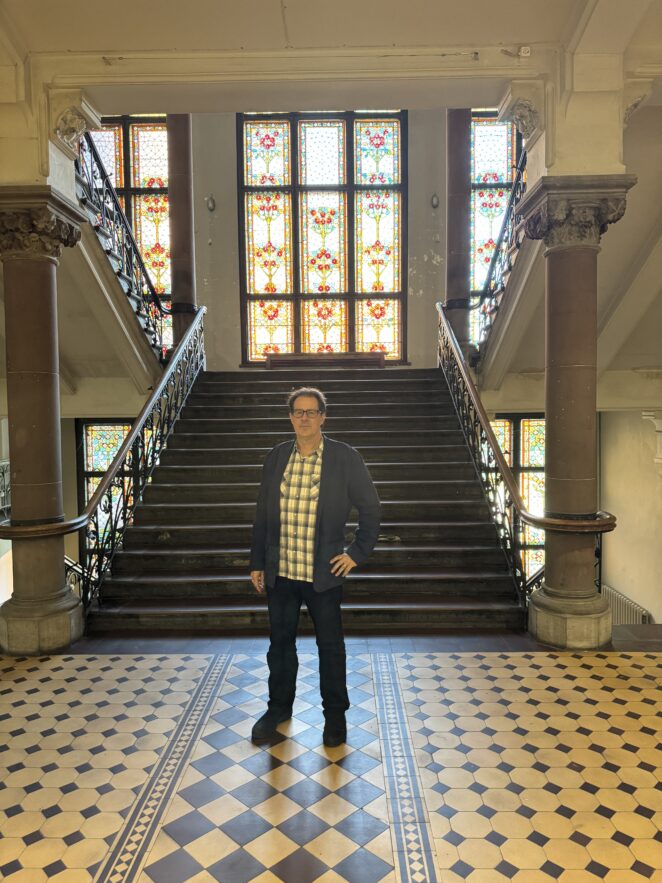
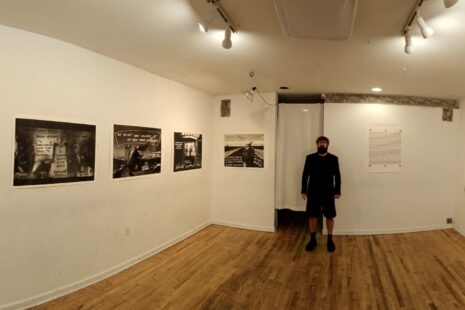
Edgar Jerins at the Art Academy of Latvia.
Can technical skill become a limitation? When a student produces an accomplished drawing that says very little, how do you help them move beyond a demonstration of ability?
I reject this idea completely. It’s an old, rather 1960s hippie idea that skill is going to limit you. If a teacher had told me to de-skill or question my skills, I would have laughed in their face. The opposite happened to me at school: I was encouraged to get as good as possible.
If you want to check your skill level, put your work up against the Old Masters. I encourage every student to focus on what they’re good at—focus on their strengths—and spend their lives getting better.
You mentioned in our earlier conversation that, in the United States, the way an artist is perceived can depend strongly on who represents them and the professional circles they belong to—which gallery shows them, which collectors buy their work, which critics and schools they are linked to. How much does that context determine how the work itself is judged?
I don’t care who represents someone, who they know, what their views are on this or that, or how much money their work sells for. I simply look at the artwork. And there are a lot of artists like me, and they’re the ones I work for.
But in the real art world, if someone is in that one percent of artists who have “made it,” their words and critiques will carry greater weight with students, regardless of how good their artwork is. Not with every student, of course.
And in the real world, doesn’t everyone want their artwork to sell for $1 million, to be invited around the world, and to be given honorary diplomas?
Latvia has a relatively small commercial gallery scene, while museums, the Art Academy, contemporary art institutions and publicly funded organisations play an important role in shaping artists’ visibility and reputations. During this visit, have you noticed a comparable mechanism here? Does a smaller art scene allow people to judge the work more directly, or do reputation and personal relationships operate just as strongly through different channels?
I haven’t really been in Latvia long enough to understand how artwork gets exhibited here. Frankly, if you were to ask me about New York, I would say that it’s who you know and being in the right place at the right time that can make your career.
I don’t think people are all that different from place to place, so I imagine things are similar here in Latvia. That’s why I always suggest that students get to know their fellow students and build their social contacts, because often it is about who you know.
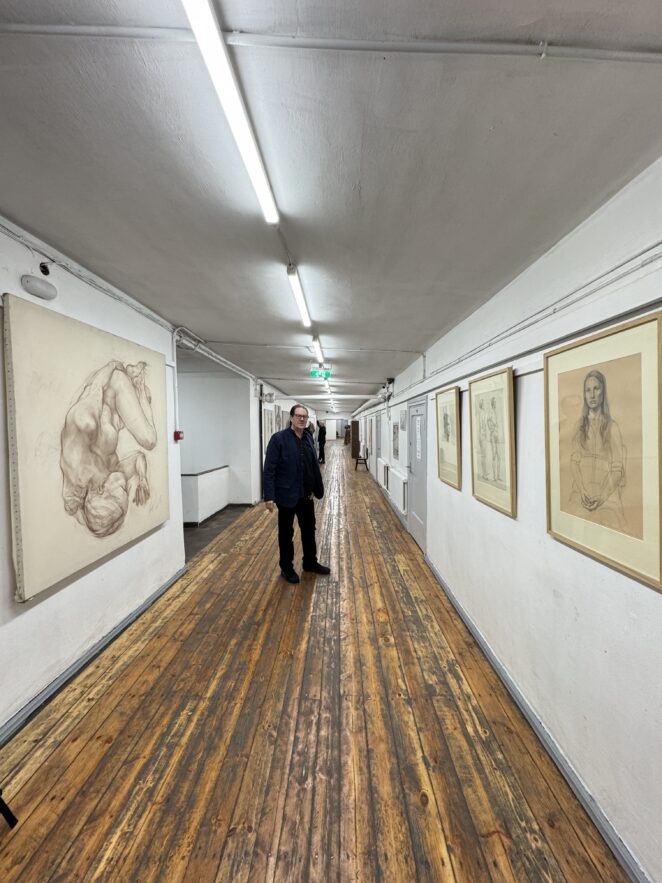
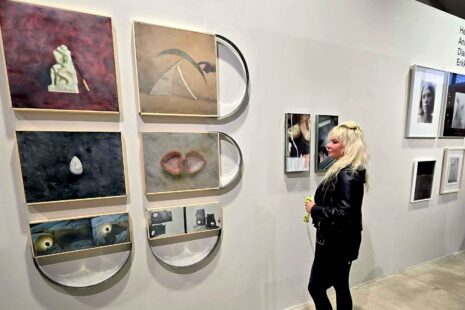
Edgar Jerins at the Art Academy of Latvia.
Riga currently has two major drawing exhibitions. From your position as both an artist and a teacher in New York, do you see real evidence of renewed interest in drawing—among students, galleries or collectors—or are we constructing a trend from a few visible examples?
I think that when it comes to art that hangs on a wall, oil is still king. But drawing underlies everything, and solid drawing is what creates a solid representational oil painting.
It’s difficult to say whether there is a trend toward drawing as a finished artwork, but I’ve seen an interest in it among my students, and it’s on display, as you mentioned, at the Latvian National Museum of Art. Each medium has its strengths.
If the appetite is real, is it a reaction to AI-generated images—or is that a convenient story? Is a charcoal drawing worth more today because a machine can produce an image in seconds?
It’s much too early to know what impact AI will have on everyone, including the visual arts. But in the same way that photography never replaced representational art, I don’t see AI replacing photography or representational artwork.
I don’t see AI replacing the experience of seeing a musician perform live. And I don’t see AI replacing a viewer’s knowledge that, when looking at a drawing, a specific artist created it with their own hand and mind. That is part of its appeal.
Of all the works in the two Riga exhibitions, which one would you put in front of your students—and what would you make them look at first?
If I were to take a group of students through both drawing exhibitions at the Latvian National Museum of Art, I think I would do the opposite of suggesting that they focus on certain works. I would allow them to lead.
I would be curious to see which artworks each student is drawn to and why. It’s a mystery what moves us in the arts. One person finds a particular artist compelling, while the person next to them is left cold.
If you had to name one change in the art world today that will matter in twenty years, and one that will be forgotten, what would they be?
I think the biggest problem I have with the art world is that the public has been removed from it and dismissed.
It would be interesting to bring the public back and show artwork in contemporary art museums that people actually like.
I don’t see that happening. There’s too much money involved, and boards of directors would like to see their private collections exhibited—and, after all, they’re paying the bills.
Me saying that power and money should not be the guiding factors in determining what is exhibited in contemporary art museums doesn’t really matter now, and it certainly won’t matter in twenty years. But wouldn’t it be nice?
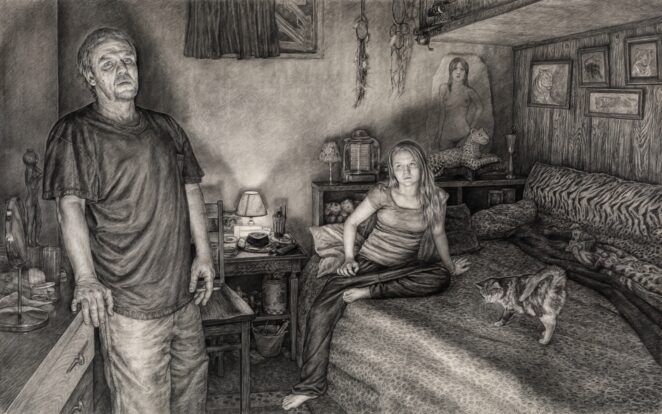
Edgar Jerins, *Francie In Her Father’s Bedroom*, 2006. Charcoal on paper, 60 × 96 cm.
Sources
-
New York Academy of Art. “About the Academy.” https://nyaa.edu/about-the-academy/
-
Latvian National Museum of Art. “Contemporary Drawings” (exhibition page). https://lnmm.gov.lv/en/latvian-national-museum-of-art/exhibitions/contemporary-drawings-589
-
Archives of Latvian Folklore (Garamantas.lv). “Intervija ar Ritu Jēriņš” [Interview with Rita Jēriņš]. https://garamantas.lv/lv/record/1709881/Intervija-ar-Ritu-Jerins
-
National Portrait Gallery, Smithsonian Institution. “Portrait Artist Edgar Jerins” (blog). https://npg.si.edu/es/blog/portrait-artist-edgar-jerins
-
Goff Books. Today’s Master: Edgar Jerins (artist interview, 2023). https://goffbooks.com/wp-content/uploads/2023/11/Todays-Master-Jerins-finished-3-Oct-2023.pdf
-
Edgar Jerins. “Biography.” https://edgarjerins.com/bio
-
Edgar Jerins. “CV.” https://edgarjerins.com/new-page
-
Pennsylvania Academy of the Fine Arts. News release on the Morris Gallery. https://www.pafa.org/news/pafa-morris-gallery-presents-fernando-orellana-his-study-life
-
New York Academy of Art. “Edgar Jerins,” faculty profile. https://nyaa.edu/graduate-program/faculty/edgar-jerins/
-
New York Academy of Art. “Drawing.” https://nyaa.edu/drawing/