Price: €20000
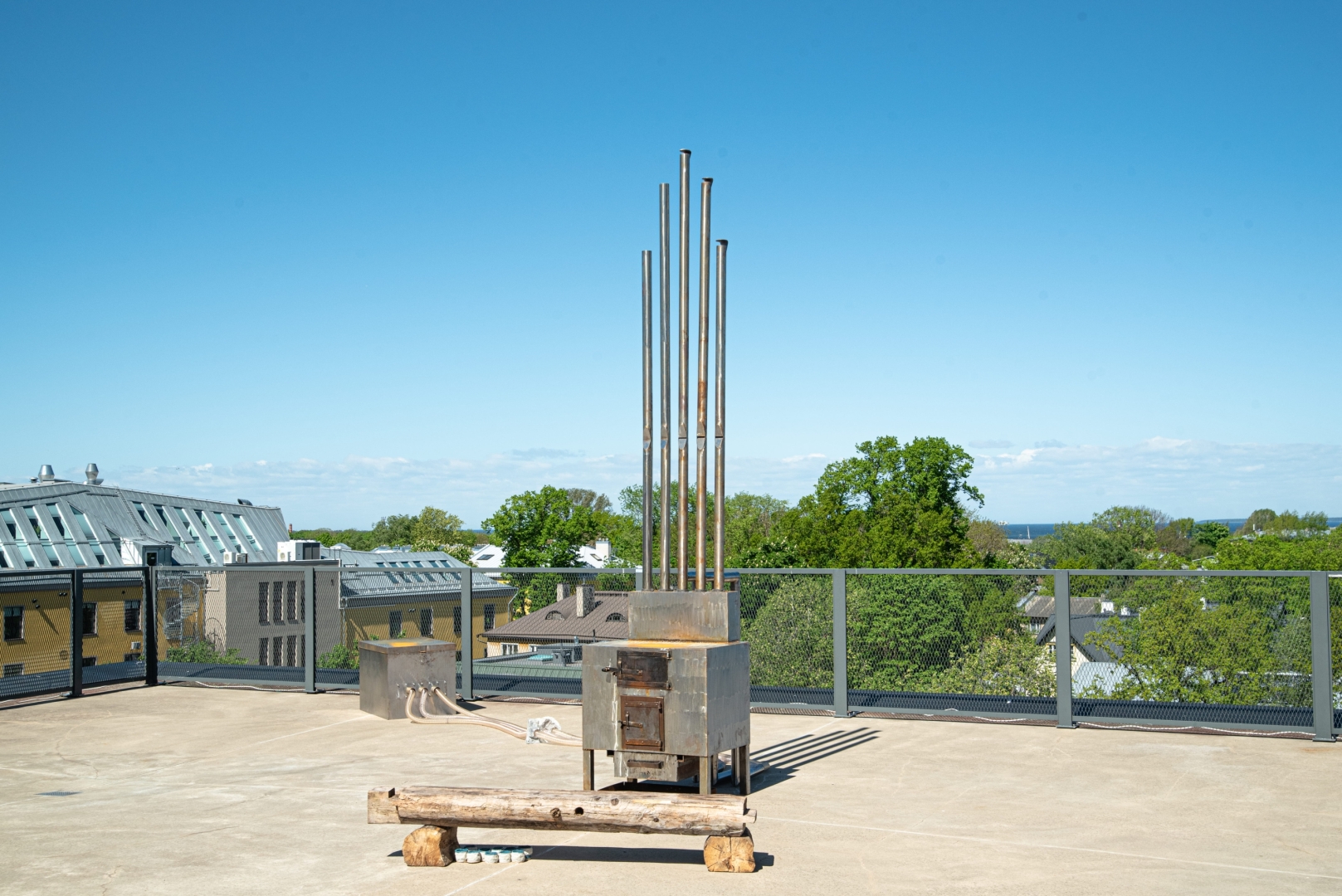


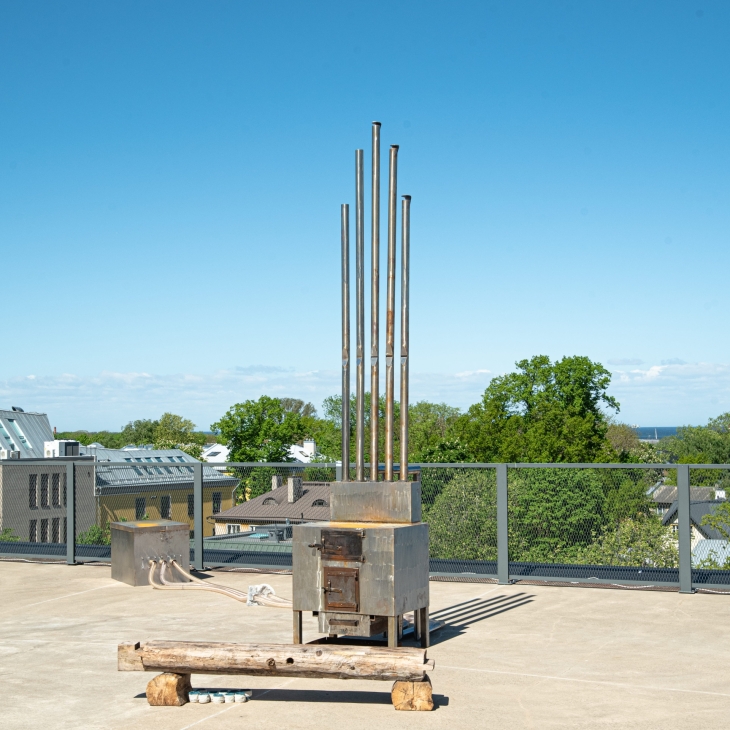
Demolished house wood (Vormsi, Saxby village), metal, ceramics, blower, sound, fire, stone, road.
Requiem Larium is an installation and ritual process that addresses the destruction of home, historical rupture, and grief. The starting point of the work is the material of a destroyed house from Saxby village on Vormsi Island. In 1944, almost the entire Coastal Swedish community of the island fled to Sweden, and many of the abandoned buildings were later destroyed and burned by the Soviet military, which took control of the island. During the period of the work’s development, daily reports of homes destroyed and burning in the war in Ukraine reached Europe. Past and present forms of destruction became entangled: homes built over centuries can disappear within hours, taking with them memories, relationships, and imagined futures. At the centre of the installation stood the remains of a former home, stacked as firewood and gradually burned in a furnace-organ constructed specifically for the work. As the wood transformed into heat, smoke, and ash, the organ pipes produced a continuously shifting soundscape. The work functioned as a requiem for destroyed homes, and as a ritual that allowed for mourning, letting go, and reconciliation. Requiem Larium is informed by a generational experience. Born in 2001, I grew up in a period marked by a widespread belief that the future would become increasingly stable, peaceful, and prosperous. Wars in Europe, the escalating climate crisis, and political polarisation have challenged that assumption. The furnace and its surrounding ritual offered a space to mourn lost promises of the future and to find consolation in a world of increasing uncertainty. The work was presented at the Estonian Academy of Arts TASE graduation festival on the fifth-floor sea-facing terrace and transitional space, and at the Young Sculptor Prize Exhibition at ARS, where it received First Prize. On the final day of the exhibition, the work culminated in a communal meal prepared on the furnace-organ by the restaurant Klorofüll, bringing together remembrance, collective gathering, and material transformation into a shared ritual.
The artwork is currently on display under an EKA grant agreement and that, if purchased, it will be transferred to the buyer in 2028.