
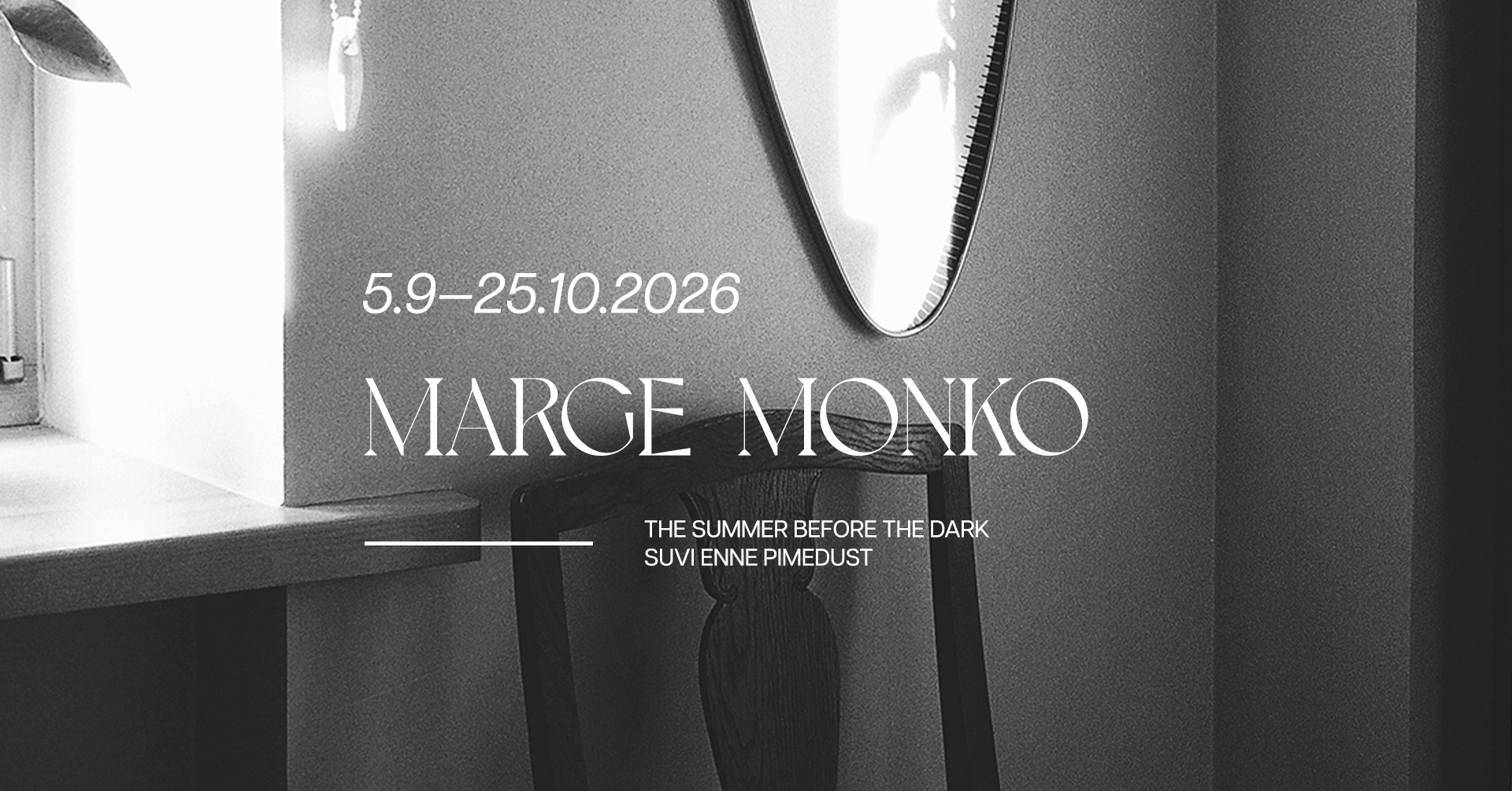
Marge Monko (b. 1976) is a well-known name on the Estonian art scene, whose work has, over the course of years, moved along the border between documentary and conceptual photography, persistently examining how the personal and the political, the intimate and the social, influence one another. Having earned a master’s degree in photography at the Estonian Academy of Arts and later leading the photography department there for years, the artist has in her earlier work engaged with the representation of women’s image, labour, and body in public space — often reflecting her own or other women’s experience through found material, archives, and the gaze of others. This exhibition turns its gaze more directly than before toward the artist’s own life: an artist accustomed to watching others here lets the viewer see her own inner world. The photographs on display deal with something that is changing, but has not yet completely disappeared.
Walter Benjamin once wrote, while unpacking his library, that every book carries within it the moment it was acquired and the place it came from: the warmth of the hand that placed it on the shelf, the shop where it was bought or the friend who lent it. A library, he said, is the materialization of its owner’s memory, an unruly and personal order that no one else can ever fully read. And yet, when visiting someone, one often steps up to their bookshelf as though it carried some secret information about its owner, one that would reveal itself through titles and authors. An outside observer never really knows whether these books have even been read. So it’s worth remembering that a bookshelf tells us just as much about who we would like to be as about who we actually are.
The life-size work “Books” (2007) on display dates from a period when Monko had recently moved and was studying in the graduate program at the Estonian Academy of Arts. There was no money for a bookshelf then, so over the years books gathered into piles on the floor, without any system — photography theory, a childcare manual, prose and poetry all mixed together. It was precisely this chance arrangement that prompted her to photograph it.
From the books, the steps lead onward to a kind of mental altar, where the light is sharper than ever before. Sleep disturbances brought on by perimenopause have opened up for Monko a play of light accompanying sunrise that she would otherwise not have noticed during sleep; the eight photographs from the series “Sun Salutation” (2026) were captured on black-and-white infrared film, a material sensitive to light radiation outside the visible spectrum.
In the series, image and text are exposed onto photographic paper simultaneously using a specially made mask. Monko has incorporated quotations from the works of female writers that address experiences of aging and age-related change. Some of the quotations come from books she had read previously, while others were deliberately sought out by the artist in the course of developing the series. No single voice outweighs the others, since all point to the same experience from different angles. The exhibition’s title is borrowed from Doris Lessing’s 1973 novel of the same name — just as one of the quotations used in the series comes from that same book. The darkness with which the exhibition’s title ends is also a beginning, from which something new starts to appear.
Cultural theorist Margaret Morganroth Gullette has written about how women’s aging is taught to be seen as a “declining narrative” long before the body itself actually experiences it. Culture ages the female sex faster and more harshly than the male sex, whose aging mostly carries marks of dignity and authority. A man whose hair turns grey is, in a sense, reborn under the title of “silver fox” — a term that has entered contemporary media usage, celebrating precisely this transition from boy to man. No equivalent title for a woman exists.
The desirability of aging men is associated more with their material power than with grey hair, and since women, in patriarchal logic, lose value mostly along with fertility, they do not have the same privilege of growing into grey hair with dignity. Menopause, as an expiration date after which a woman can no longer bear children, comes in this framework to mark the beginning of darkness.
Yet alongside the fetishization of youth, many scholars have also drawn attention to a somewhat healthier narrative. The term “postmenopausal zest” is often associated with anthropologist Margaret Mead: according to her observations, many women, after the onset of menopause, actually experience a rise in energy and freedom, an escape from the social and biological constraints tied to reproductive capacity. This feeling, however, is often buried under society’s silence and prejudice.
A similar conclusion is reached from another direction in evolutionary biology’s so-called “grandmother hypothesis,” which attempts to explain why menopause exists at all. Menopause itself is what makes the human case unusual, since most other species’ females remain fertile until death. According to the “grandmother hypothesis,” women’s long life after their fertile years is not an evolutionary accident but a direct benefit: older, no-longer-childbearing women increase, through their help and knowledge, their grandchildren’s chances of survival, thereby helping to pass on the genes carrying this longevity to future generations.
Though the idea is beautiful in itself, this hypothesis too is actually outdated, carrying the same old expectation that a woman’s worth lies in her contribution to someone else’s life. In reality, the postmenopausal — or any other — stage of life does not need justification through offspring or caregiving. The freedom that “postmenopausal zest” signifies should not depend on whether a woman gives birth, raises children or cares for someone else.
The freedom to be alone, without the compulsion to prove one’s worth to anyone, is however not the same as loneliness. Gloves without their partner are a good example of such loneliness, one that can be linked to ultimate dependency — when one is lost, the value of the other diminishes considerably; one could even say its function practically disappears. Thus a glove is also a direct indexical trace of something that no longer exists.
Gloves without their partner, left by a passerby on a fence post or the edge of a trash bin so their owner might find them, had caught Monko’s eye before, but the thought of photographing them seemed too obvious. Only in the winter of 2022 did she begin photographing them, mainly around the Kalamaja district, since hunting for lone gloves gave a good excuse for longer walks. The series born from this, “Do I Even Know What It Is, From Which None Can Escape ” (2024), borrows its title from a poem by the Estonian poet Viivi Luik.
Alongside the gloves, another body of material began to accumulate: photographs of strangers’ hands, bought from eBay’s “collectibles” section, in the same way Monko has sourced photographs and negatives for earlier works. For most of them, nothing is known about their background; some are classified as “hand studies” — apparently material once produced for drawing instruction in art school photography departments — while in others a hand is used to present an object or provide scale. These unknown hands and the solitary gloves enter into dialogue in Monko’s series: ten UV-coated pigment prints and six silver gelatin photographs, present and past brought together.
While the gloves carry the trace of a stranger’s absence indirectly, the work “To Liina” (2018/2026) brings that feeling closer to the artist’s own flesh. In two mirroring self-portraits, the artist poses with her back to the camera. The photographs were taken in 2018, shortly after the death of Monko’s maternal grandmother. In one, Monko is bare from the waist up; in the other, she wears her late grandmother’s floral robe. Farewell and dedication are here not so different from one another: mourning is not a letting go of something, but a clothing of oneself in it, carrying the trace of what was lost until that trace becomes one’s own skin.
Text: Emel-Elizabeth Tuulik