Participating artists: Marge Monko, Tõnis Saadoja, Mihkel Ilus, Johanna Ulfsak, Jass Kaselaan
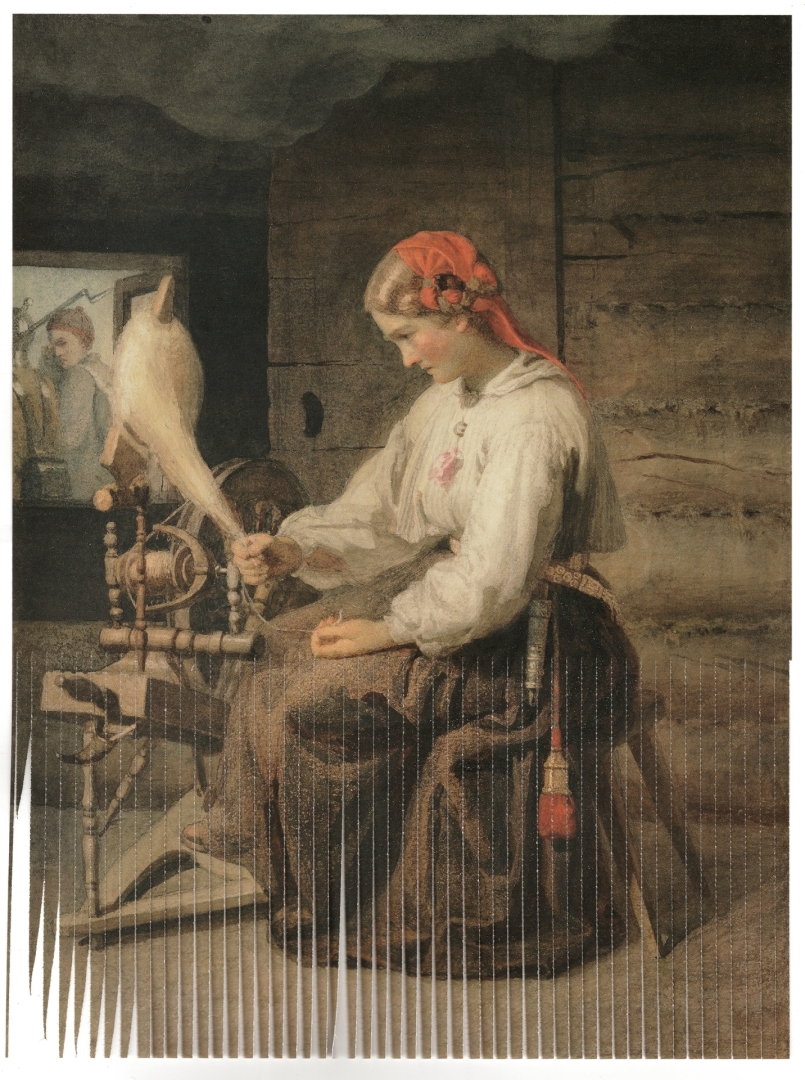
Johann Köler is an artist whose works have likely been reproduced more than any other in Estonia. His paintings can be found in albums, monographs, and on postcards. Using the watercolor The Spinner (Broken Thread) as an example, Marge Monko (1976) examines the reproduction of an artwork as a process whose success depends on both photographic and printing-related aspects. The work consists of reproductions of “The Spinner” printed at different times, as well as two interpretations of the piece created by the artist herself.
Monko has previously used Köler’s watercolor The Spinner in her practice — at the 2012 Köler Prize nominees’ exhibition, where she displayed a reproduction shredded halfway through a paper shredder under the title Broken Thread. She chose this work because it allowed her to create a conceptual link with the history of the Kreenholm Manufactory and the textile industry, which at the time was a central focus of her artistic practice. In the present exhibition, Monko further develops the work by additionally presenting a photographic reproduction shot on medium-format film and enlarged in an analog color laboratory, composed of test strips in different tones. Monko collaborated with graphic designer and colour proof specialist Marje Eelma to create this work.
Tõnis Saadoja’s (1980) two oil paintings both stem from the same question — how to paint a motif that would simultaneously align with Köler’s academic legacy while also being shifted by contemporary modes of seeing. The prototypes for the paintings are Köler’s landscape sketches and studies of foliage, which were exercises for his larger compositions. The expression of an unmistakable and logical painter of nature today feels like an old classical language — one that is studied and learned, yet no longer spoken in everyday artistic practice. Searching for a shared sensibility or common ground with Köler inevitably resembles taking flight, distancing oneself, and attempting to land safely on familiar terrain.
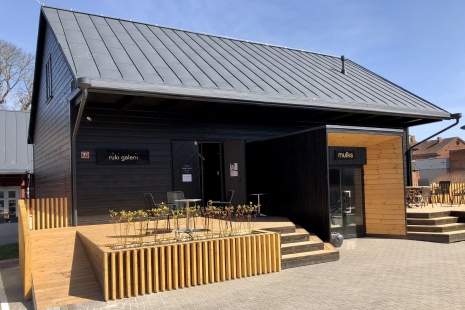
Over the years, Mihkel Ilus (1987) has worked with ideas that directly stem from the material aspects of the painting process. His attention has been drawn to stretcher frames, tension wedges, the linen weave of canvas, and easels as the painter’s primary tools. The artist has handcrafted 30 easels, based on prototypes used in the painting department of the Academy of Arts, originally made after Eduard Ole’s easel, behind which Mihkel Ilus himself has both studied and taught. Thus, the artist’s easels are themselves a repeated tribute to cultural transmission. For the easels exhibited at Rüki Gallery, the artist crafted painting clips from noble wood dating from a period preceding Köler’s birth. The easels provide support for Tõnis Saadoja’s paintings.
Köler’s painting Lorelei Cursed by Monks is considered one of his most ambitious works, although critics gave it a devastating assessment at his solo exhibition in Vienna. The dynamic composition depicts the water witch Lorelei, whose power and strength the monks have come to destroy. Behind the painting saturated with brutal effects lie additional personal layers: the composition also portrays the Crusaders’ invasion of Livonia and the clergy’s desire to eradicate pagan beliefs. The symbolic significance of Lorelei and Köler’s personal resentment toward the clergy inspired Johanna Ulfsak (1987) to create two textile works in double-weave technique for the exhibition. The first warp, in deep green tones of the Rhine River, intersects with the second warp, dramatic night darkness. The threads intertwine and separate according to the artist’s intuition, with the aim of conveying the struggle between light and shadow, and good and evil, as depicted in Köler’s masterpiece.
Jass Kaselaan’s (1981) sculptural group Portraits from the Year 2026 is based on the idea of how to portray a subject who does not actually exist. The sculpture series engages with the portrait tradition established by Johann Köler, yet shifts its foundation: while the classical portrait affirmed a person’s identity, here identity is open and potential. The sculptures depict fictional individuals — the human figure is recognizable, yet lacks biography and fact-based background. The portrait does not represent anyone specific, but instead creates presence in itself. Thus, the portrait becomes not a means of proof, but a mode of representation capable of giving form to someone who exists only within artistic space.
From the works of Johann Köler (1826–1899), the exhibition at the Rüki Gallery includes his painting Italian Landscape (1859–1861). The artwork, which belongs to the collection of the Viljandi Museum, symbolically connects the artist’s local origins with his international experience. In addition, the study, painted outdoors, shows the artist’s personal style more clearly than his academic portraits.
The triple exhibition will be accompanied by a major additional program, with more information available online at www.koler200.ee.