
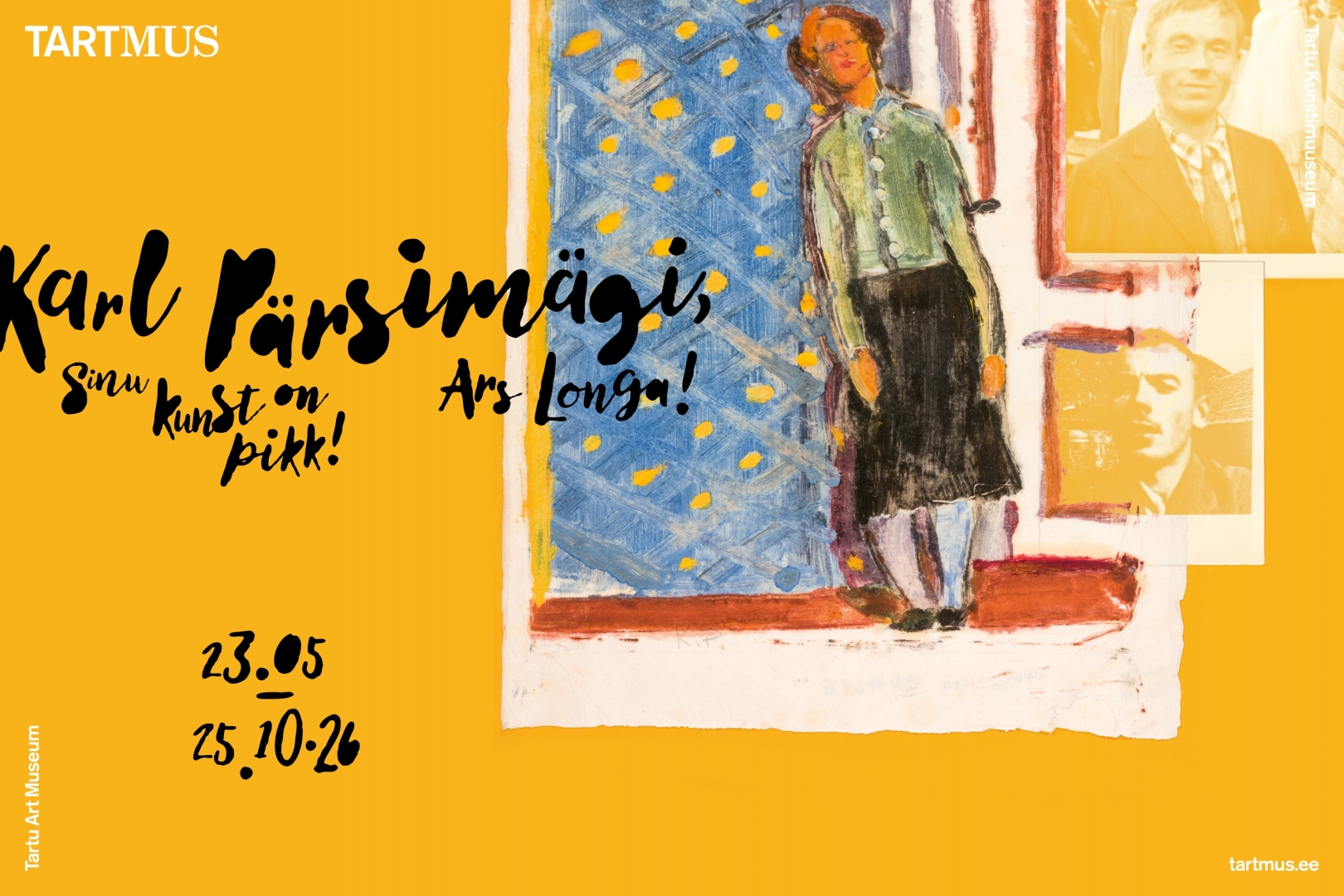
Karl Pärsimägi (1902–1942), born on Sika Farm in the village of Oe, near Antsla in Võru County, dedicated himself to art at an early age. He began his studies in the Pallas Art School under Konrad Mägi. The freedom that characterised the early years of Pallas enabled Pärsimägi to fully develop what was already present inside him: a unique sense of colour.
The rich selection of works exhibited in the Tartu Art Museum invites the viewer on a journey to the place where Pärsimägi felt most at home. The paintings, studies and sketches in different media reflect Pärsimägi’s travels in artistic space, moving through simple recurring motifs and vibrant combinations of colour, always seeking perfect harmony, introspective depth, playfulness, melancholy and the lightness of being.
Pärsimägi, who his contemporaries remembered as a contradictory, introverted person, tended to wear ragged, simple clothes, yet in his art he lived with incredible force, passion, fantasy and elegance. “When I look at Pärsimägi’s works I can’t help but regard all of the formal innovations as a kind of admission, a flamboyance that he could only indulge in through paint,” writes Harry Tafoya.
The Pärsimägi enigma, which ensures the continued attractiveness of his work, is impossible to fully explain. The charm of his paintings mostly lies in their simplicity, the stunning accuracy achieved in spite of a great economy of means. Behind it lies a huge amount of work, effort and experimentation, yet the viewer sees none of that. There were those among Pärsimägi’s contemporaries who couldn’t perceive the true essence of his seemingly simplistic works, the sincerity and earnestness of the world-view that is communicated in them. Pärsimägi’s works stood out and made otherwise drab exhibitions sparkle.
The importance of Pärsimägi for following generations of artists is remarkable. Throughout Estonia’s occupations and the Soviet regime, Pärsimägi’s paintings served as an embodiment of Western modernism and artistic freedom. Young artists secretly went to see his works in the Tartu Art Museum, the painting collections in Tallinn’s Kadriorg Palace, the homes of Pärsimägi’s relatives and his home farm of Sika. A Pärsimägi-esque sensibility can be found in the works of several artists who came after him, such as Henn Roode and in the early works of Valdur Ohakas.
The exhibition explores the places that played a central and important role in Pärsimägi’s life. Besides art, his favourite places were undoubtedly his home in Võru County, the towns of Võru, Tartu, Viljandi and, finally, Paris. Perhaps Pärsimägi dreamt of Paris even before he could put a name to that dream. His artistic spirit was born in Võru County and was closely connected to the special Southern Estonian genius loci, but his artistic attitudes were in lockstep with modernist movements that emphasised the power of colour. Behind the often rural subject matter and seemingly unrefined earnestness of Pärsimägi’s works lie a complex tonal balancing act and a refined sense of colour. The safe and familiar domestic interiors with children playing the piano depict moments spent with the families of his sister and brother in Viljandi and in Võru. Paintings with motifs from the monastery in Pechory are from his trip there with his close friend Eduard Timbermann in 1934. But above all Pärsimägi was interested in observing the presence of a person, especially a lone female figure, in a room. A part of the exhibition is dedicated to the artist’s skill at depicting people, free of any prejudice: his rapid manner of painting, built on simplicity and colouristic harmony, communicates Pärsimägi’s respect for the human being as a beautiful enigma.
Pärsimägi’s self-portraits, the portraits made of him by artist friends, and photographs taken of him, attempt to get closer to his mysterious personality, his process of self-observation and self-discovery, both through painting and through the lens of a camera.
Pärsimägi’s disarming earnestness and genuine sincerity are some of the qualities that ensure the continuing relevance of his art. Contemporary painters highly appreciate his skill at depicting people and his lightness, which stand out against the sombre attitude towards life and art so typical of Estonians. Intimate reflections from the authors of the exhibition texts allow us to see the impact that Pärsimägi’s works have made on people. The cruelty of the outside world condemned him to an early death, but his art lives on.
The exhibition is accompanied by a richly illustrated catalogue with articles by the curator, the art historian Heie Treier, and the American art critic Harry Tafoya, along with reflections and thoughts on Pärsimägi’s works from Kristi Kongi, Jaan Toomik, Enn Lillemets, Mare Joonsalu, Olav Maran, Sonja Svarts and Mari Vallikivi.
Curator: Liis Pählapuu
Exhibition design: Peeter Krosmann
Graphic design: Angelika Schneider
Coordinator: Rene Kriisa
Exhibition texts: Heie Marie Treier, Harry Tafoya, Mare Joonsalu, Enn Lillemets, Mari Vallikivi, Olav Maran, Jaan Toomik, Kristi Kongi, Sonja Svarts and Liis Pählapuu
Exhibition team: Indrek Aavik, Richard Adang, Nele Ambos, Siim Asmer, Indrek Grigor, Joanna Hoffmann, Mare Joonsalu, Margus Joonsalu, Katrin Lõoke, Kadri Mägi, Jaanika Peebo, Anti Saar and Ago Teedema


