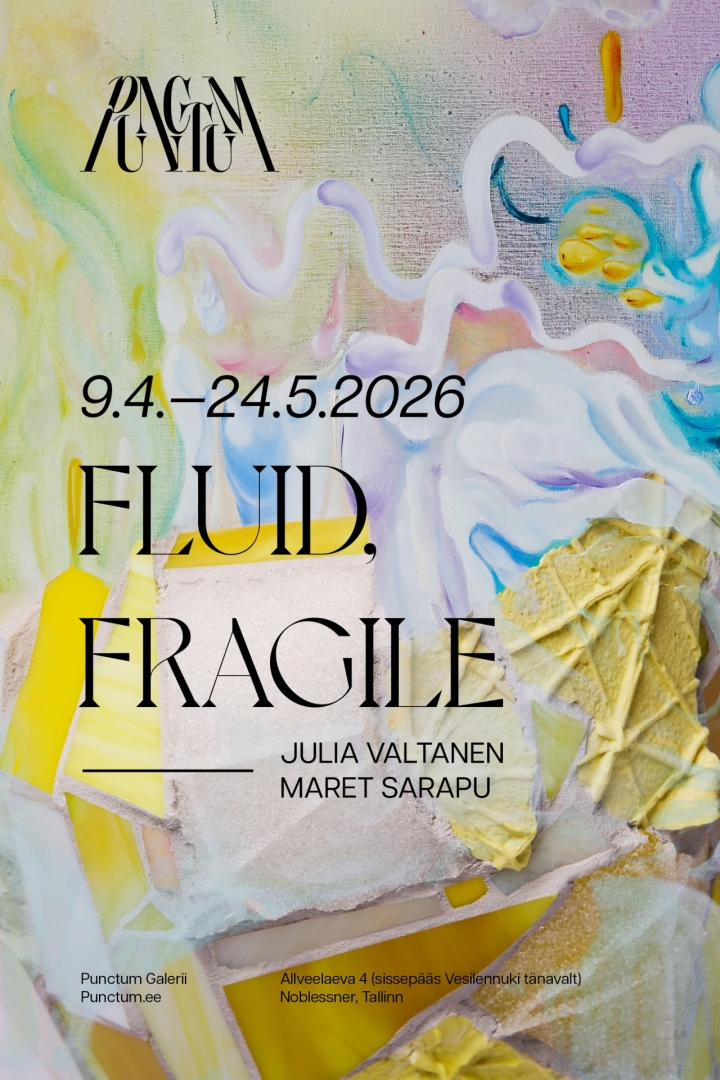
In Julia Valtanen’s works, forms are fluid, they flow into one another, creating hybrid, organic structures. The composition has no center, and its elements are not subordinated to hierarchy; the viewer’s attention is distributed across the surface, as if in an ecosystem where everything is intertwined and interconnected. In her new works, the pictorial layer remains dynamic: she allows the paint to flow, giving the material greater agency. There is also more air, more pauses, more breathing space in her recent pieces.
Julia’s collages become an important transition within the exhibition. Unlike painting, where form emerges through flow, here it is cut out and defined by a clear edge. The fragment appears, along with the layering of different planes, while the empty spaces become traces of absence, equal parts of the composition. Collage introduces a principle of assembly that is then continued in the practice of Maret Sarapu.
In Maret’s works, form is also unstable, but for a different reason: it depends on perception. Glass, reflections, and light create situations in which the image changes as the viewer moves. The angle of view, as well as the intensity and quality of light, determine what becomes visible. The layers here are not painterly but optical – they are shadows and refractions that generate multiple versions of the same image.
A special place is given to the amphora – an archetypal form known as a symbol of wholeness and stability. In Maret’s work, it is covered with a fragile mosaic, turning into a surface assembled from fragments. Here, the unified form is sustained by a multitude of individual elements, each retaining its autonomy. The whole emerges not in spite of the fragment, but because of it.
In the artistic practices of both artists, fragmentation does not mean destruction. On the contrary, the fragment becomes a way of assembling a world that is layered and ever-changing.
“Fluid, Fragile” is a space where fluidity and fragility are not opposed but complement one another. Matter, form, and perception exist in a state of continuous transformation, where interconnections prove more important than the objects themselves.
The exhibition is supported by the Cultural Endowment of Estonia.