Price: €860
With the exhibition An Order of Things, Malmö Konstmuseum examines how the ideas behind the encyclopedic museum continue to shape our way of seeing, organizing and understanding the world, while at the same time being constantly challenged and changed by new perspectives and perspectives.
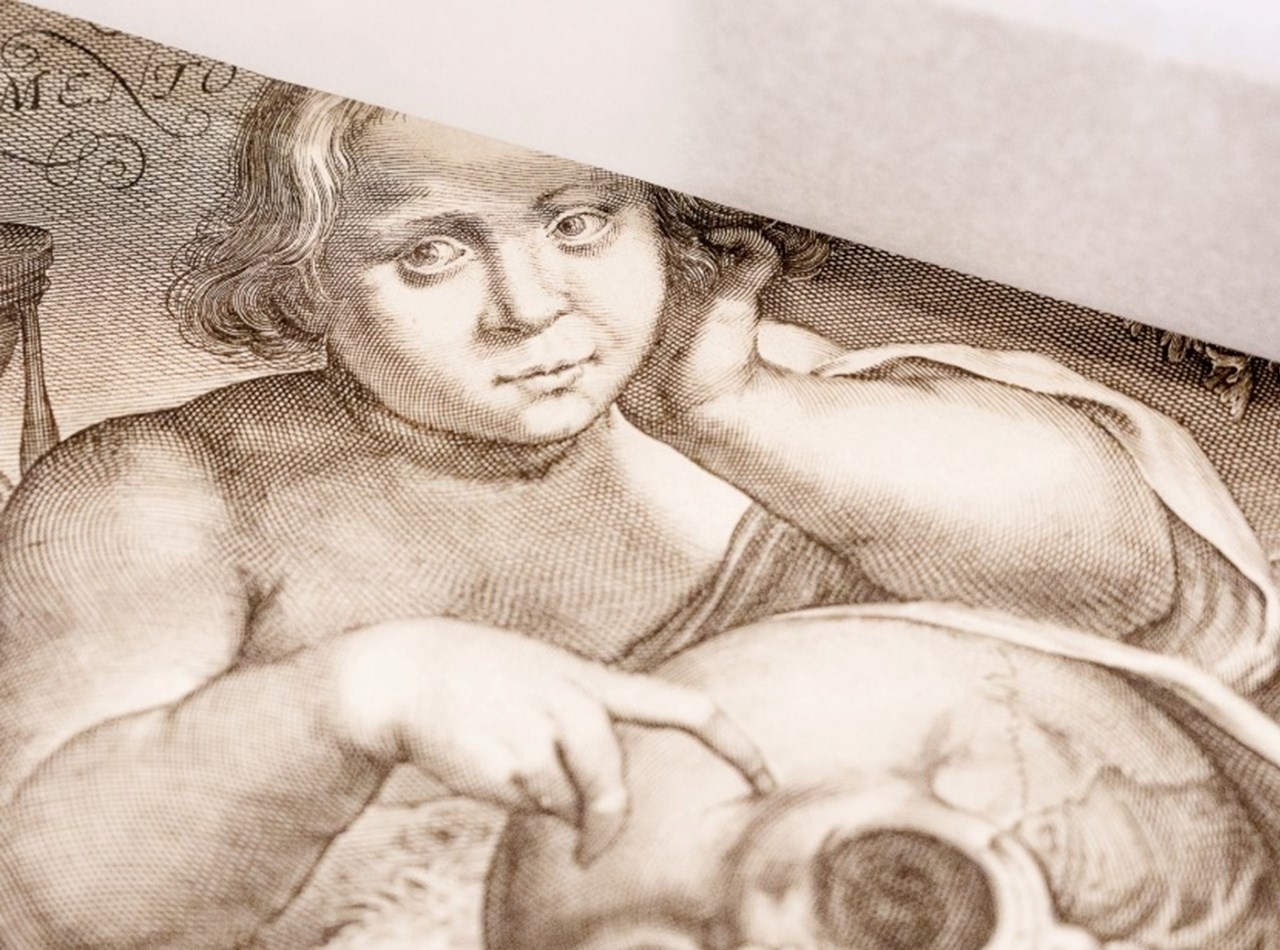
Simon de Passe, Memento Mori, 1612-1615, beskuren. Foto: Henrik Hellström/Malmö Konstmuseum
When Malmö Art Museum was founded in 1841 as part of Malmö Museum, the ambition was to create an encyclopedic collection in the spirit of the Enlightenment – a universal system of knowledge where the world could be mapped and made understandable through collection and categorization. In this order, natural history, ethnographic, archaeological and art history objects were gathered side by side, as parts of a common worldview.
But divisions and systematics are not neutral acts. Naming and ordering are also creating boundaries, hierarchies and values. “An Order of Things” makes these structures visible and reflects on how museum collections both enable and limit our understanding of the world, and how these ideas still live on in today’s knowledge production.
The exhibition’s title takes inspiration from Michel Foucault’s book “The Order of Things: An Archaeology of the Human Sciences” (1966), in which he shows how systems of knowledge are constantly changing and being replaced. In the same way, “An Order of Things” creates a scene where historical orders meet contemporary interpretations.
The exhibition is divided into thematic rooms – natural history, ethnography, archaeology and art history – where works from the collections of Malmö Art Museum and Malmö Museum meet works by contemporary artists who question or reformulate these categories.
Among the participating artists are Ida Brockmann (DK), Mark Dion (USA), Maxime Hourani (LB), Clara Ianni (BR), Irene Margrethe Kaltenborn (NO), Michael Rakowitz (USA) and Cecilia Westerberg (DK).
Ida Brockmann’s sculptures “Reading of a Ruin” (2024) and “One Moment and some Million Years” (2024) reflect on time, loss and translations between history and the present.
Mark Dion’s graphic work “The Lost Museum” (2021) allows the museum’s family tree to grow through history, from the nine muses to today’s institutions, and connects science to mythology.
Maxime Hourani’s video work “Twice Removed” (2017) explores the role of the museum in shaping historiography and shows how removed stories expose power structures and ideological shifts.
Through her installation “Union (Syndicate)” (2024), Clara Ianni makes visible how Western classification systems and AI technology continue to reproduce power and order.
Irene Margrethe Kaltenborn’s video work “Choreographies Towards Loss” (2024) becomes a poetic requiem for the extinct gar bird – and for our relationship to the lost.
Michael Rakowitz recreates destroyed archaeological objects in colorful everyday materials in the work “The Invisible Enemy Should Not Exist (Room G, Northwestern Palace of Nimrud, Panel 28)” (2019) – as ghosts that testify to loss, provide comfort, and make wrongs visible.
Cecilia Westerberg’s “The Alchemist’s Laboratory” (2025) opens up a room for workshops where science, art and magic meet in a contemporary interpretation of the Renaissance cabinet of curiosities. In three different rooms, visitors are invited to explore, discover and create.
As a dialogue with the exhibition, “The Condition Report”, curated by Marie-Nour Hechaime and Sara Rossling, is presented – video works by artists Noor Abed (PS), Ariella Aïsha Azoulay, Omar Mismar (LB) and Nour Ouayda (LB), which examine the politics of conservation and care, and how stories and experiences are often made invisible in museum systems.
The project “I Like Maps Because They Lie”, curated by Marika Reuterswärd, explores the dual nature of the map – as both a scientific tool and a cultural construct – where power, subjectivity and symbolism are intertwined.
Galerii nimi: Malmö Konstmuseum
Address: Malmöhusvägen 6, 211 18 Malmö, Sweden
Opening hours: Tue-Wed 11:00 - 17:00 Thu 11:00 - 19:00 Fri-Sun 11:00 - 17:00
Open: 21.11.2025 — 23.08.2026
Address: Malmöhusvägen 6, 211 18 Malmö, Sweden
Opening hours: Tue-Wed 11:00 - 17:00 Thu 11:00 - 19:00 Fri-Sun 11:00 - 17:00
Ticket info: Adult SEK 40; Children and young people 0-19 years free entry; Students SEK 20 (valid student ID must be presented)
Open: 21.11.2025 — 23.08.2026