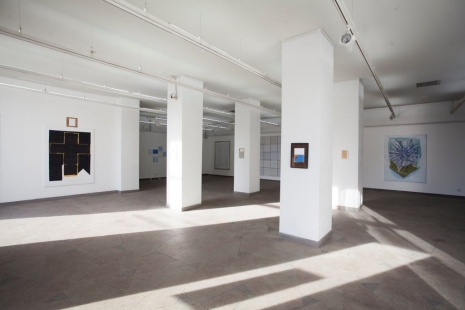
“Eigengrau” (German for “intrinsic grey”) is a term associated with the German psychiatrist, philosopher, physicist, and mystic Gustav Theodor Fechner. Also referred to as “dark light” or “brain grey,” it is not a pigmentary colour in the conventional sense, but rather a phenomenon generated by the brain – an illusion produced by the eyes and perceived in complete darkness. It is the quiet background of the mind when light has faded: a colour that exists within our consciousness and appears differently to each individual.
This concept of perception functions as a key architectural principle of the exhibition, opening a space for reflection on the multiplicity of realities and the subject’s relationship to them. Painting intersects with video and sound installation, while digital technologies are woven into the construction of the works. Together, painting, screens, artificial intelligence contexts, and personal experiences form a unified yet continuously shifting perceptual field.
Three main segments emerge in Klaidas Paškevičius’s exhibition: the subject (the human), virtuality, and landscape. Here, the portrait functions as both an archetype of collective consciousness and a form of individual perception. Virtual reality is understood as an all-encompassing, active environment – an inescapable backdrop of contemporary life. Landscape becomes a critical reflection of physical reality, offering a space to experience presence, to slow down, and to return to oneself.
The exhibition engages with current explorations of the relationship between digital and physical space, where human and artificial worlds increasingly intersect in art, revealing points of contact, conflict, and perceptual anomalies. Within this encounter, the artist examines transformations of the world and the complex relationship between the human being, the body, and existence following the rise of virtual culture. He is particularly interested in processes in which physical reality gradually dissolves and overlaps with a generative environment – a perceptual field shaped by algorithms and simulation.
Klaidas Paškevičius is an artist whose practice reflects contemporary life and its aesthetic forms, extending beyond traditional painting techniques. Oil painting, pastel, and aerosol paint are combined with digital media in his work. His artworks can be perceived as simulations – hybrid constellations of the physical world, images created in virtual space, and imagination. Central to the artist’s approach are the poetic, introspective recording of states, the symbolic and contextual dimensions of the works, and the artwork as a space of emotional intensity and authentic experience.
Organiser: Pamėnkalnio Gallery.
Sincere thanks to: Brigita Butkevičiūtė, Gedas Mekšriūnas, Mantas Valentukonis, Šarūnas Baltrukonis, Alberta Vengrytė.
Financed by: Lithuanian Council for Culture, Vilnius City Municipality, Lithuanian Artists’ Association