
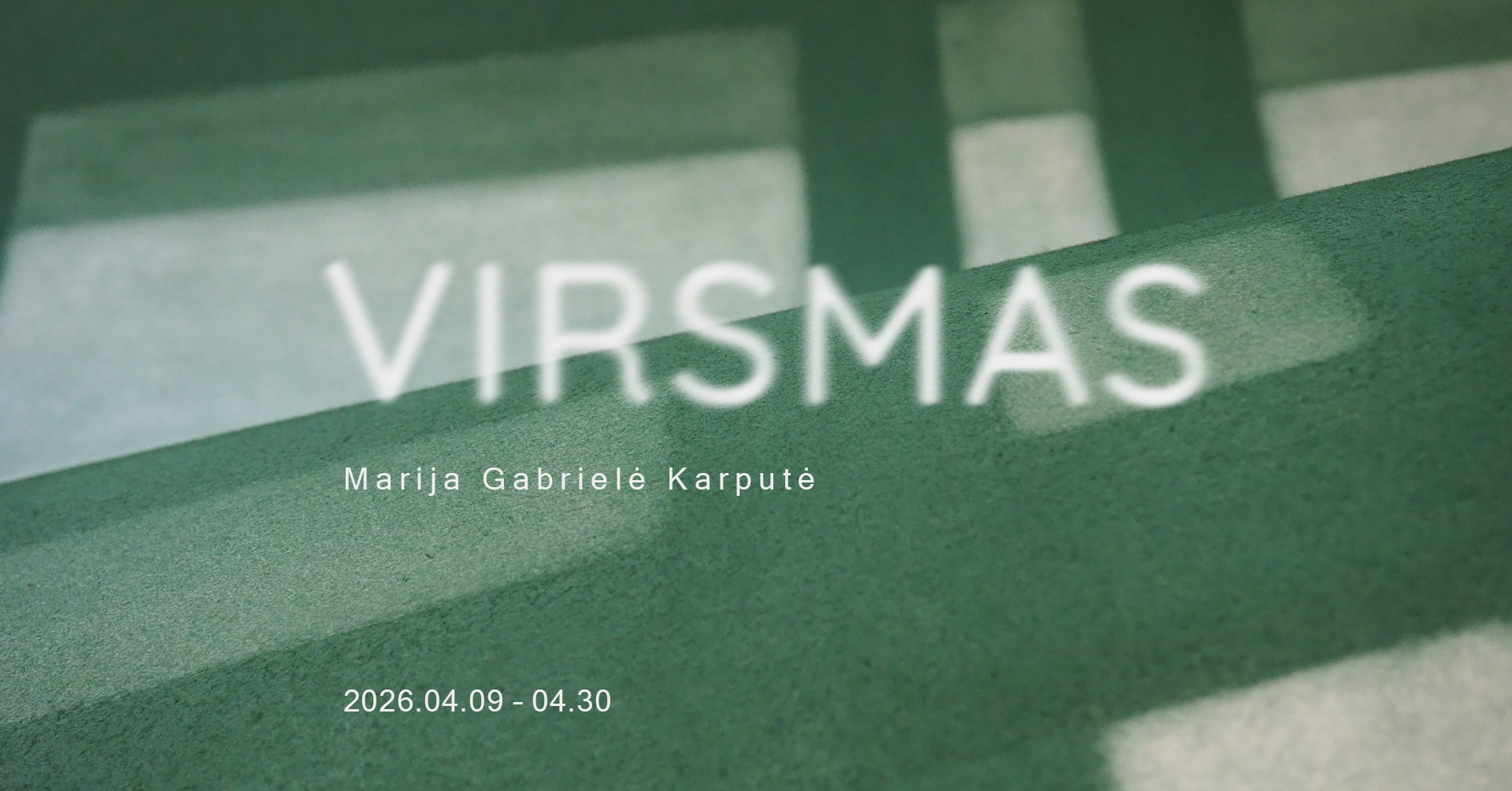
Marija Gabrielė Karputė (b. 2000) is an artist of the younger generation. She explores themes of time and memory in her work, addressing both tangible and intangible traces of time and intertwining personal narratives with the collective narrative. Karputė earned her master’s and bachelor’s degrees in graphic arts from the Vilnius Academy of Arts and studied at the Helsinki Academy of Fine Arts in Finland. Her work has been exhibited in group shows in Lithuania, Poland, Finland, Spain, Serbia, and the Czech Republic. In 2023, M. G. Karputė was awarded the Vytautas Jurkūnas Graphic Arts Prize. Although she has a background in graphic arts, her work transcends traditional printmaking boundaries and often takes interdisciplinary forms. The principles of graphic arts – the print, the line, and the mark – are incorporated into site-specific installations, artists’ books, sculptural objects, and texts.
“For more than a decade, the Meno Niša Gallery has worked with emerging artists. This project, launched in 2011, continues today in a new form. Meno Niša: Open Call. This project introduces artists to the professional art scene, from gallery spaces to international fairs, and has helped over 30 artists launch their creative careers. Among the applications for the Meno Niša: Open Call project, M. G. Karputė’s work stood out for its conceptual coherence and thoughtful use of materials. The artist transforms everyday objects into meaningful structures that reveal layers of time, memory, and human experience,” says gallery director Diana Stomienė.
M. G. Karputė draws inspiration for her work from her surroundings, everyday life, and the details of daily existence that are often overlooked at first glance. These elements serve as a means of exploring how objects’ surfaces accumulate the passage of time, memories, and traces of human existence. “The moment of recognition is important to me – when the viewer sees something in the work that is close to their personal experience,” the artist reveals. At the center of the exhibition is the series of drawings, Blankets. Here, quilts and fabrics are perceived as surfaces that absorb body warmth and touch. The repetitive use of these blankets imprints human experience into them, revealing a sense of shared humanity through the tactile perception of the fabric present in each of our memories. According to M. G. Karputė, this silent history of humanity is revealed not through events, but through their subtle traces.
Other works in the exhibition explore various forms of transformation. For example, candy wrappers found and collected at a flea market are transformed into shimmering objects. Though they are carefully preserved, they raise questions about hoarding, value, and the fragility of objects. Meanwhile, other pastel drawings serve as references to the virtual world. They reflect our contemporary relationship with dreams. Their playful visual aesthetic conceals a more complex relationship with desire, which takes on new, artificial forms when transferred to a digital environment.
At the Virsmas exhibition, visitors are invited to observe and identify different surfaces and textures. They are also encouraged to view transformation as an intermediate state and reflect on their own transformations – how everyday life shifts imperceptibly between states. Thus, the viewer’s relationship with the image is revealed through the duration of their gaze and level of concentration.
The Virsmas exhibition will run until April 30.
The project is financed by the Lithuanian Council for Culture. The project is partially financed by the Vilnius City Municipality.


