Lisafotod


Holding Together, 2026
280 x 660 x 1000 cm
€92310
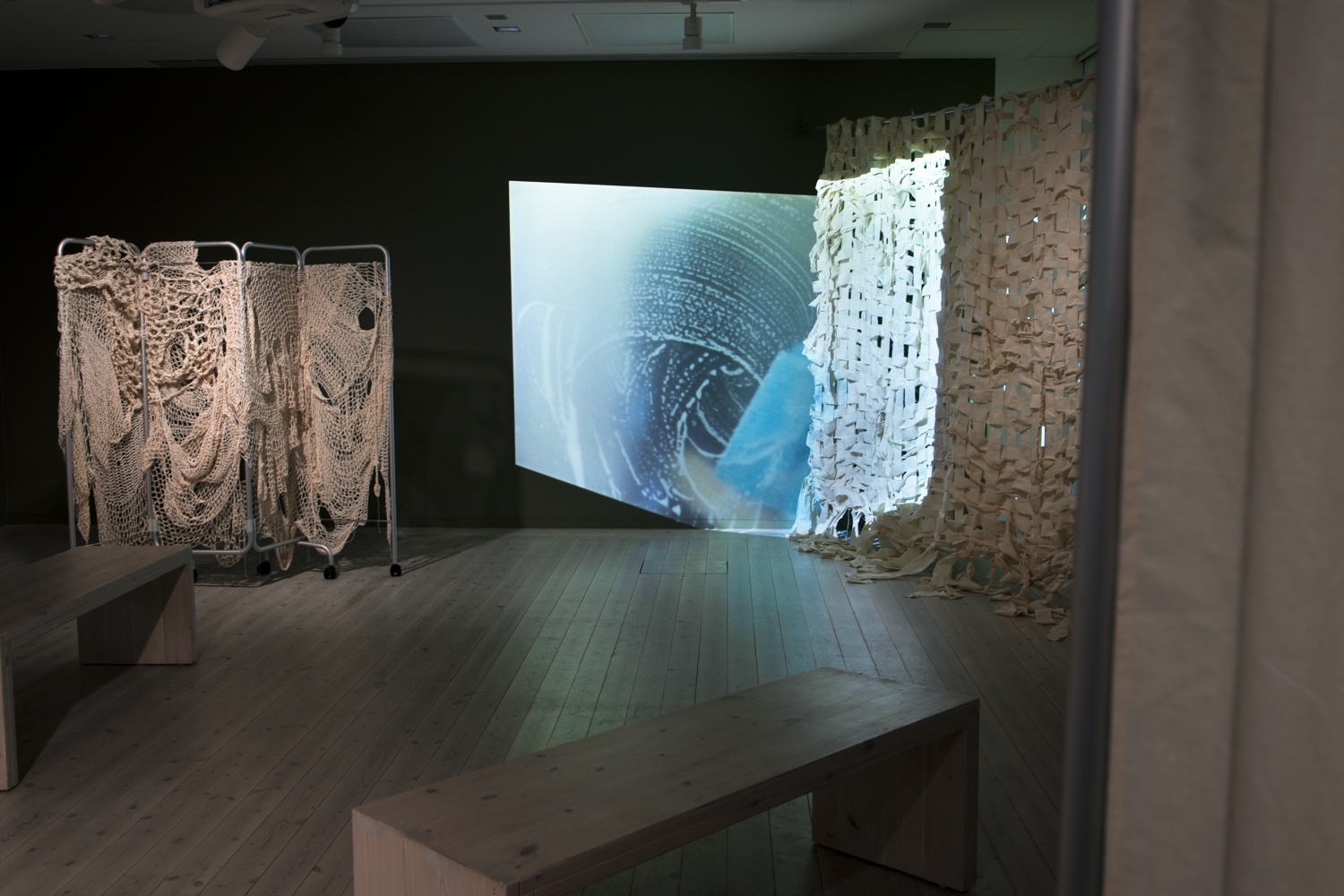
Installation with sound (23:26 minutes), projected video loops, cotton fabric, cotton yarn, screen partition frames, and video on monitor (17:14 minutes)
My work focuses on the role of relatives—what it means to stand beside someone who is ill. At the same time, I have worked with the fractures that emerge when healthcare systems fail to see the whole person. The work asks what happens when support becomes conditional and family members are left carrying responsibilities that no institution is willing to assume. By turning attention to the relatives, I seek to make visible an often overlooked struggle that unfolds both in the home and in encounters with the healthcare system.
My interest began with a desire to understand my mother’s experience of being the parent of a child with mental illness. I started from the personal, using our relationship as a point of departure to approach something larger—care, kinship, and how the healthcare system functions, or sometimes fails to function. Over time, my work has also come to address language and communication.
The central element of the installation is a sound work that plays throughout the space. It consists of reconstructed telephone conversations based on a script that my mother and I developed together from real conversations she had with psychiatric services, social services, and other healthcare providers during a period when I was severely ill with anorexia. Because of multiple overlapping conditions, I fell through the cracks of a fragmented healthcare system. These conversations function as material through which I seek to illuminate the relationship between the individual and society.
A monitor displays a video of my mother’s hands and my own. They gently stroke and care for each other. A conversation unfolds between us about codependency, parenthood, and finding ways to navigate difficult periods.
The installation also includes two projections. In one, a stop-motion animated ball of yarn moves like a tangled organ, pulling in different directions. The other projection shows the endless wiping of a glass wall that never seems to become clean. A kind of Sisyphean task, perhaps functioning as a coping strategy.
Another recurring material in my practice is textiles, which reference the body, care, and acts of nurturing. These are materials that women have woven, washed, ironed, made beds with, and dried for generations. In the artistic work, care resides both in the material itself and in its encounter with the human body. Handcraft also carries representations of relationships and traces of language. The sound piece contains spoken language, where words sometimes prove insufficient, and this is placed in dialogue with the textile—the words ‘text’ and ‘textile’ share the same etymological origin. I am interested in the meeting between different forms of language: the medical and institutional language of systems, and the more personal language of lived experience.
Finally, my mother’s voice bears witness to these experiences, her concern and perseverance set against the shortcomings of institutions. Our voices carry experiences shared by many, yet experiences that are rarely given space on their own terms. At the same time, I have worked to give these themes a spatial form, allowing that which cannot be expressed in words to be articulated through the installation itself.
The work is part of the MFA graduation exhibition at Umeå Academy of Fine Arts in Sweden and is on view at Bildmuseet in Umeå throughout the summer of 2026.