
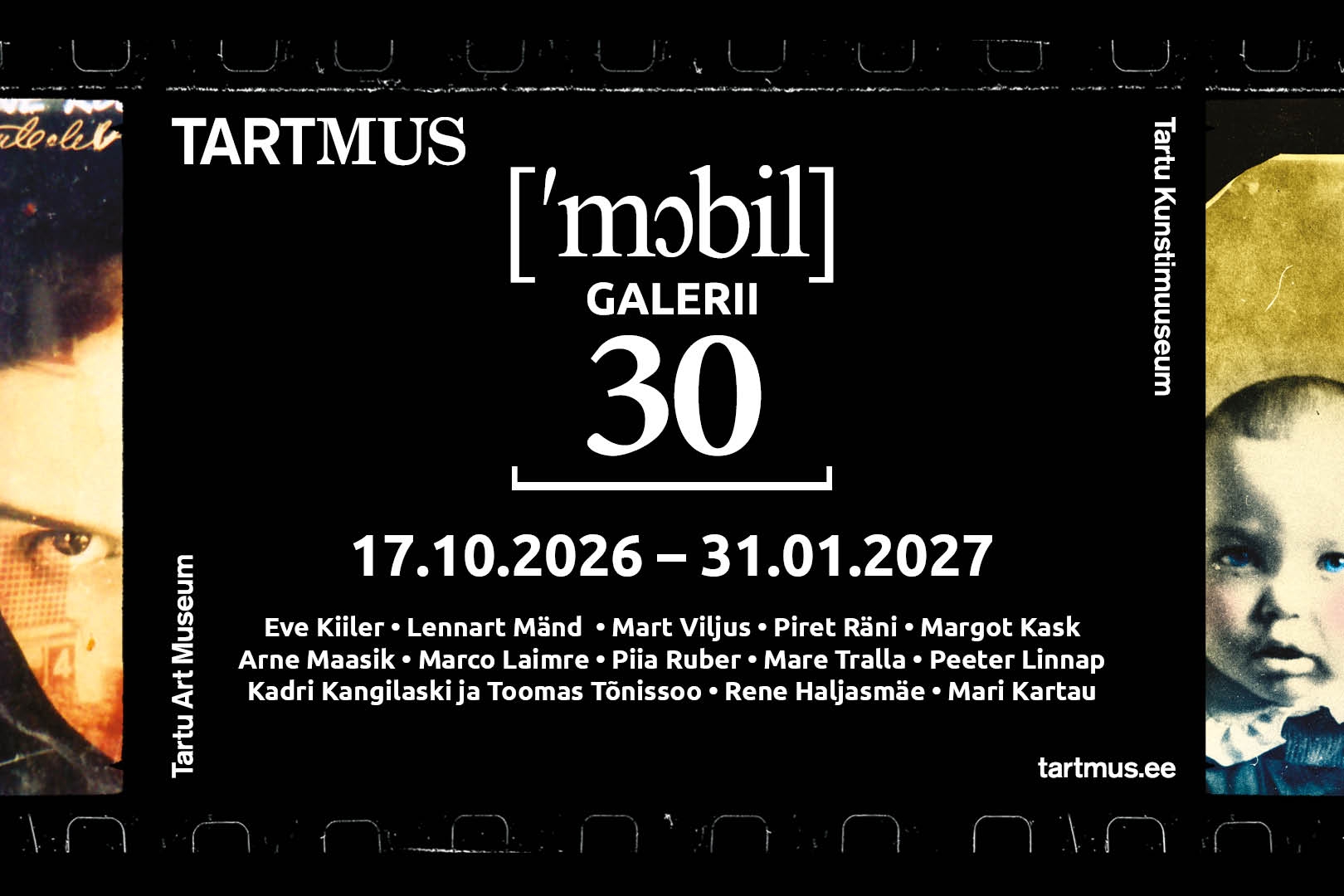
The [‘mɔbil] Gallery (1995–1998) was a collaborative project of art students and the lecturers Peeter Linnap and Eve Kiiler (then Linnap). The group got its start from the lectures on contemporary art and art theory given by Peeter Linnap, who had started work in the Estonian Academy of Art’s photography centre. Peeter hung a sign reading “Faculty of Taste” on the centre’s door, which saw lively debates and after-hours discussions. Thanks to these discussions and their participation in the Saaremaa Biennial 1995 The History Factory / Fabrique d’Histoire’s student exhibition The History Artel, the students, led by Marco Laimre, decided to continue working together under the name the [‘mɔbil] Gallery in October 1995. At that time they had no idea of the impact they would have on Estonian art history.
The [‘mɔbil] Gallery referred to exhibitions curated by the students themselves, which moved freely outside of the framework of official art institutions. [‘mɔbil]’s manifesto stated: “Total independence, emphasised by the lack of a fixed spelling of our name (presented only as a phonetic transcription) and of a fixed location, allows the [‘mɔbil] Gallery to be flexible and to present the latest ideas in art. /…/ The [‘mɔbil] Gallery exhibits intellectual, socially oriented art. This stylistic preference can be considered one of its main reasons for being. The [‘mɔbil] Gallery is the shared project of a group of artists who value the social message of art.”
Many of the artists who participated in the [‘mɔbil] Gallery as students have gone on to make names for themselves in the Estonian art scene: Marco Laimre, Piret Räni, Lennart Mänd, Andrus Kõresaar, Margot Kask, Killu Sukmit, Mari Laanemets, Martin Pedanik, Piia Ruber, Rene Haljasmäe, Anders Härm, Kadri Kangilaski, Jasper Zoova, Kristjan Mändmaa, Anne-Daniela Rodgers (then Saaliste), Mari Kartau (then Sobolev) and Mare Tralla. Mart Viljus, a scientist, conceptual artist and photographer working at the Tallinn Technical University, was also an important participant. The intellectual leaders in the Faculty of Taste’s headquarters were Peeter Linnap and Eve Kiiler.
Most of the mobilists, second- or third-year students who had begun broadening their horizons in the lectures on contemporary art given by Peeter Linnap, enthusiastically placed photography- and installation-based conceptualism at the centre of their world view. The nineties were a whirlwind of post- and self-colonialism, and the young students were excited to be a part of them and turn them into art: they had to catch up to the artistic developments that they’d been deprived of. They were trying to become a part of the Western cultural sphere,
where conceptualism based on photography and found objects had been a respected part of exhibitions for decades.
The young artists who had entered the art world through the History Factory wanted to show how history is constructed, to show the relativity of “objective” information, to present strategies of manipulation, and to teach people to doubt the memory and reality constructed by victors. So many interesting topics needed handling: the lack of an objective truth; the exposing of the mechanisms of manufacturing truth; simulations, fabrications and narratives; subjective confessions; the problems of sign–meaning relations; the determination of interpretational possibilities; the power to define and to set rules; manipulation, advertising, psychic terrorism etc.
During its short period of activity, the [‘mɔbil] Gallery organised twelve group exhibitions and countless solo exhibitions of its members’ works. In the first half of 1997 the group once again turned its attention to working as volunteers in organising the Saaremaa Biennial Invasion, in which many members of [‘mɔbil] also took part. With Invasion the story of [‘mɔbil] came to an end. Participation in the biennial was like a certificate of maturity; they had made it from the student exhibition to the main event, from there on they entered adulthood. In 1998 there was one last exhibition, the OUT festival of urban space, which was a mournful obituary for the [‘mɔbil] Gallery’s golden age.
This exhibition, dedicated to the [‘mɔbil] Gallery’s 30th anniversary, brings together the few works from that time still surviving and wholly new works from former members of [‘mɔbil] which continue their analysis of the process of writing history.
Participating artists: Eve Kiiler, Lennart Mänd, Mart Viljus, Piret Räni, Margot Kask, Arne Maasik, Marco Laimre, Piia Ruber, Mare Tralla, Peeter Linnap, Kadri Kangilaski and Toomas Tõnissoo, Rene Haljasmäe and Siram
Curator and graphic design: Piret Räni
Coordinator: Rene Kriisa
Exhibition team: Indrek Aavik, Richard Adang, Siim Asmer, Indrek Grigor, Joanna Hoffmann, Margus Joonsalu, Viktor Kiss, Katariina Leets, Katrin Lõoke, Anti Saar, Kristel Sibul, Saara Sion and Mihkel Säre


