
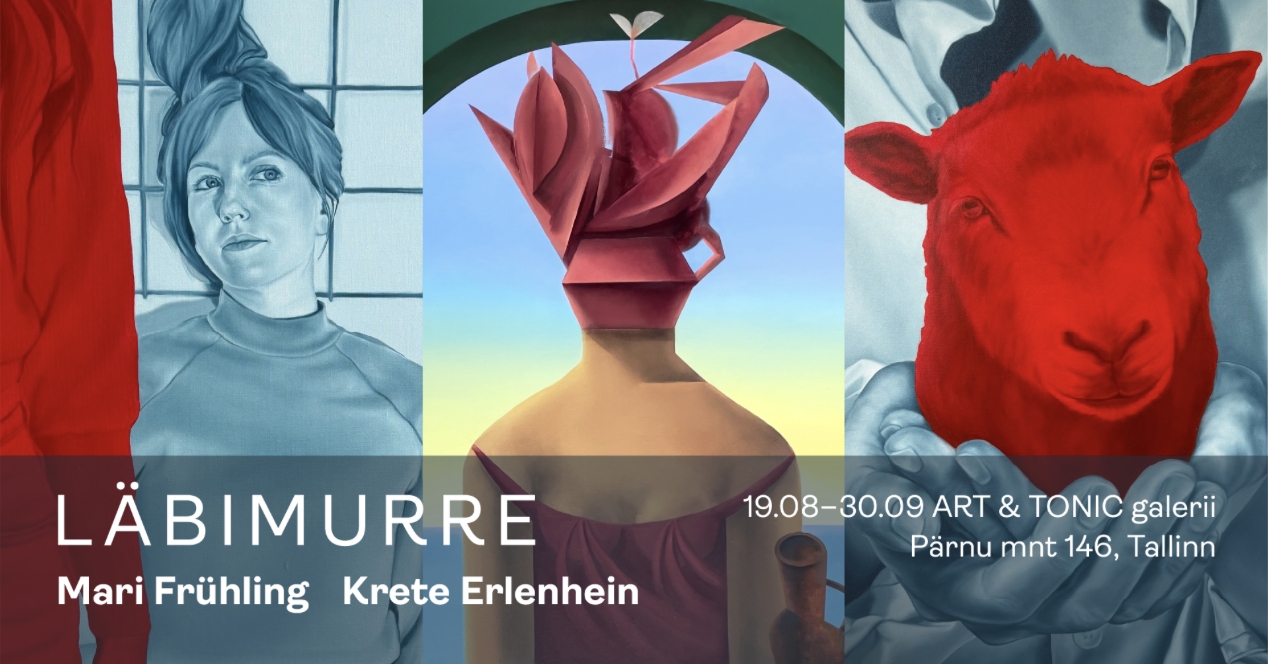
“Breakthrough” is an exhibition in which Mari Frühling and Krete Erlenhein jointly express their shared concern for other species in a world where the use of animals is the default norm. The title also contains the phrase “through concern”, which conveys the feeling that is at the core of the artist duo’s collaboration. The exhibited paintings are accompanied by reflections that focus on questions of ethics and aesthetics through vegan and feminist discourse.
We ask, what is the meaning of the title “animal lover” in a society where animal killing can be a paid job or a work of art, and saving an animal is activism? Who is appropriate to mourn in such a case and who is not?
On the basis of personal observations, we argue that people are happy to agree with animal rights activists as long as veganism is mentioned, just as they agree with human rights activists as long as feminism is mentioned. As human animals and women, we perceive a clear common ground between the two social justice movements mentioned.
We would like to offer comfort to like-minded people who are familiar with the concern for animals bred for helplessness in the background of everyday life. To prevent worry from turning into a passive, self-destructive thought, we feel a responsibility to address the topic through creation. By breaking through the worry, we express hope that facing the tension and accepting it as a feeling can generate an impulse for small changes or even a paradigm-shifting breakthrough.
The theme of the exhibition is based on the conviction that extending empathy to animals is safe for humans, but vital for other species.
Mari: With these paintings, I continue to develop the topic of animal rights, which I have previously dealt with in the painting series “Shared Space” (Tartu Art House 2024) and “Dissonance Trilogy” (Gallery Pallas 2025). The three series of paintings are united by a reference to the possibility and necessity of the development of empathy in human society through self-reflection.
With this series, I open up personal emotional levels that I experience from time to time as a vegan in a non-vegan world. The contrasting colours and straightforward transitions in my paintings symbolize the tension field of the dual world, where a person is constantly moving from one dissonance to another. In the modern world, where confrontation often arises faster than the desire to understand each other, this movement turns into a manoeuvre in search of balance. With these paintings, too, I strive for clarity and harmony, which can arise from the coexistence of apparent opposites and learning from each other.
When painting, I try to avoid art objects that contain animal components. I use synthetic brushes and water-soluble oil paints with a vegan label, which also allows me to give up the use of solvent.
Krete: My work moves on the border between cubism and surrealism, where fragmented forms and displaced images create a space for the exploration of empathy, identity and inner tensions. I often use female figures through whom I deal with vulnerability, caring and resistance. For me, the female figure symbolizes those whose voices often remain in the background in society.
I see a connection between women, the less privileged and animals, who are united by the need to be seen as a sensitive and valuable living being, not just as a tool. The desire to stand for the well-being of the “weaker” has accompanied me for years, and at the Estonian Academy of Arts I have started to explore this topic more consciously in my work, looking for connections between empathy and social justice.
My works do not offer ready-made answers, but invite the viewer to notice contradictions and ask whose point of view has been left unheard. I believe that art can broaden our empathy and help us make sense of our relationship with other people and other species.


