
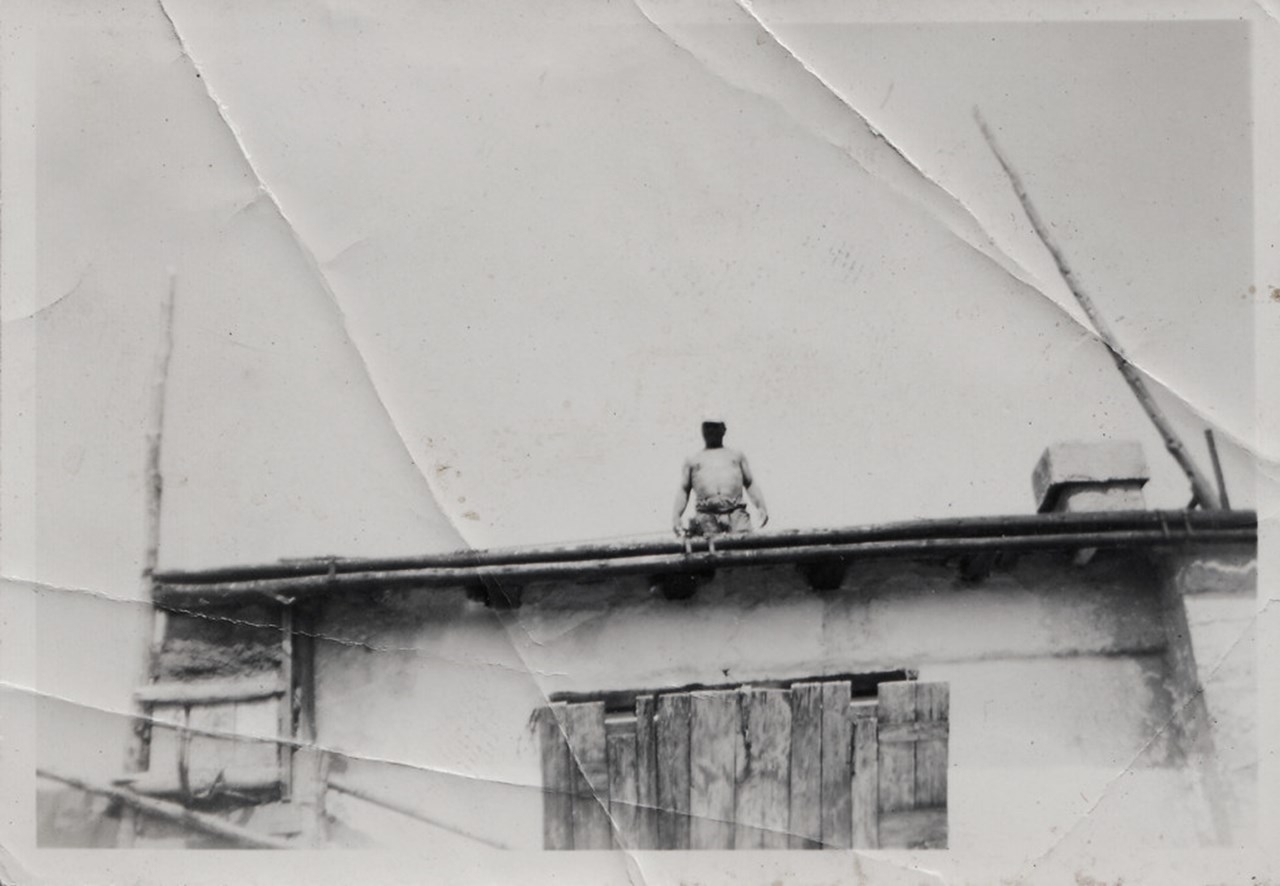
Armored bunker or hut? Defensive wall for a Skåne village or brutalist sculpture? In “DEFENSE” we move in the borderland of twilight light – between fantasy and reality, between play and seriousness. Here there is barrenness and rigid paranoia. But also the deepest care.
It was on the plains of Skåne, near Hörby, that farm worker Karl-Göran Persson (1894–1975) transformed his home into an armored fortress – a protection against the war he feared but that never came. He cast his fear in concrete and his loneliness became masonry in a structure that still towers over the fields, like a mysterious embodiment of collective anxiety.
“VÄRN” marks the culmination of a twelve-year art project in Karl-Göran Persson’s footsteps. When John Skoog and his collaborators built a reconstruction of Karl-Göran’s building work for the film, the work evolved into a joint artistic exploration. The result – a monumental sculpture – is now on display for the first time.
Karl-Göran Persson was part of the community, but at the same time he took a position on the sidelines. In the borderland between the everyday affairs of adults and the children’s bunk building and war games, he began the lifelong transformation of his home in the 1930s. During the Second World War, after the information leaflet “If War is Coming” was first sent to Swedish households in 1943, the project gained new momentum – and continued during the great power tensions of the Cold War.
The structure was intended to provide shelter for all the village’s inhabitants – and for the king. Over the decades, Persson collected metal and scrap from a rapidly changing agriculture – materials that he dragged home and cast into the concrete as reinforcement. Encased agricultural tools, bicycle parts and milk jugs appear in the masonry like fossils from a previous society. They bear witness to the shift in Swedish agriculture brought about by modernity and a changing relationship between people, machines, animals and landscape.
Karl-Göran Persson’s seriousness and stubborn care were borne of a rationality that was also sensitive to something more fragile, more unbridled. Was his approach excessive? Naive? Irrational? Perhaps. But what then is a reasonable response to the threat of war – and what is war if not the collapse of humanity and reason?
About John Skoog
John Skoog (born 1985 in Kvidinge, Skåne) is an artist and filmmaker based in Copenhagen. After studying at the Städelschule in Frankfurt (graduated in 2012), he has worked with film, video, photography and installation. He often returns to the areas where he grew up – to the people, the machines, the natural landscape and the twilight light. In his works, he combines historical research and careful observations of everyday life with a poetic tonality. His working process is characterized by profound collaborations with people both in front of and behind the camera. In parallel with his artistic work, he runs the nomadic cinema Terrassen in Copenhagen and works as a professor of film at the Academy of Fine Arts in Mainz. John Skoog is represented in the Moderna Museet collection with two works: “Late on Earth” (2011) and “Shadowland” (2015).


