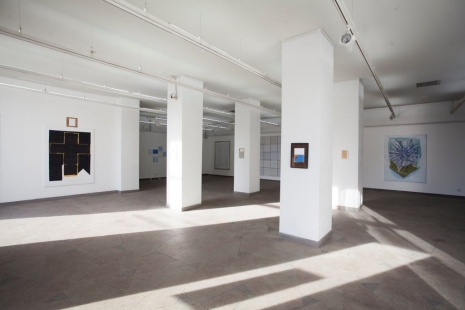
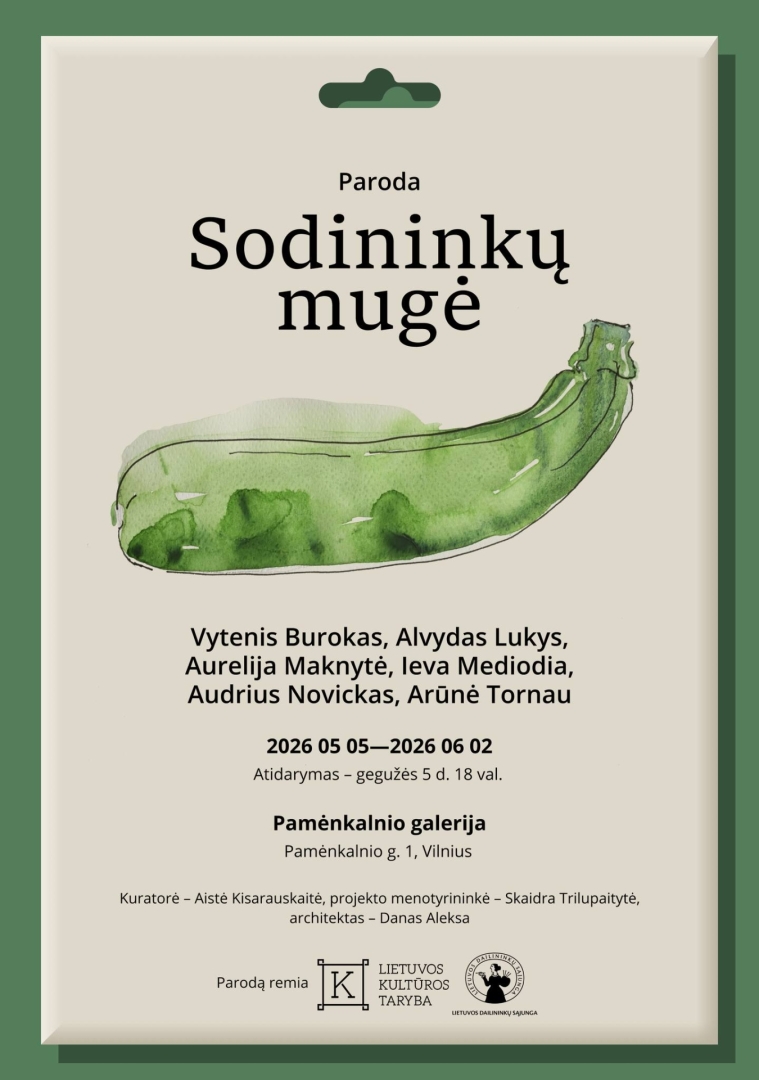
The exhibition Gardeners’ Fair explores a space where art grows alongside the garden, and where the rhythms of life outside the city shape artistic practices. It reveals artists’ engagement with gardening as a distinct network of exchange, where sharing, relationships, and collective experiences give rise to an informal creative environment.
Curator Aistė Kisarauskaitė:
“Artists have long been drawn to rural retreats, spending their summers in country homes or even relocating there permanently. One of the most famous ‘escapees’ from the city was Vincent van Gogh. His colleague Paul Gauguin went even further — all the way to Tahiti. In both cases, stepping away from the urban environment opened up new possibilities in painting.
Even during the Soviet period, when city dwellers were not allowed to purchase rural properties, many Lithuanian artists still found ways to acquire them and would spend entire summers there. Following Lithuania’s independence, these practices became more visible. One notable example from the early 2000s were exhibitions organized by Marija Teresė Rožanskaitė and Igoris Piekuras with their sons at their homestead in Dzūkija. Large audiences gathered to see sculptures and watercolours displayed in meadows, as well as the artist’s monumental ear sculptures (Forest Ears, 2003) attached to pine trees.
Contemporary artists also frequently choose to live partly or permanently in rural settings. Among them is something of a “Gauguin No. 2,” Juozas Laivys, who in one of his projects adopted the identity of the famous Post-Impressionist. Visitors go to Laivys’ homestead not so much to view artworks as to bury them in the Cemetery of Artworks. Artists also travel to Laura Garbštienė’s former railway station in Marcinkonys, now home to the Verpėjos Residency. Yet for many, the homestead remains a place of retreat — even from fellow artists. In such contexts, connections become less visible, though they persist through shared seedlings, seeds, and ongoing exchanges of experience.
This exhibition seeks to create a space for artist-gardeners to act freely, without limiting the exhibition to what is conventionally defined as an artwork — just as life in a rural setting does not impose such boundaries. One may choose to weed the garden, prune trees, or create artworks, and to decide whether these everyday activities constitute an artistic practice.
One of the key aims of the project is artistic freedom, allowing artists to present what matters to them: traditional art forms, interdisciplinary practices, or even produce grown in their gardens. The exhibition reflects on rural artistic practices, the evolution of ideas, and the presence — or absence — of cultural connections.”
Organiser: Pamėnkalnio Gallery
Curator: Aistė Kisarauskaitė
Public programme lead: Skaidra Trilupaitytė
Architect: Danas Aleksa
Designer: Augustė Glinskytė
Sponsored by: Lithuanian Council for Culture, Lithuanian Artists’ Association.