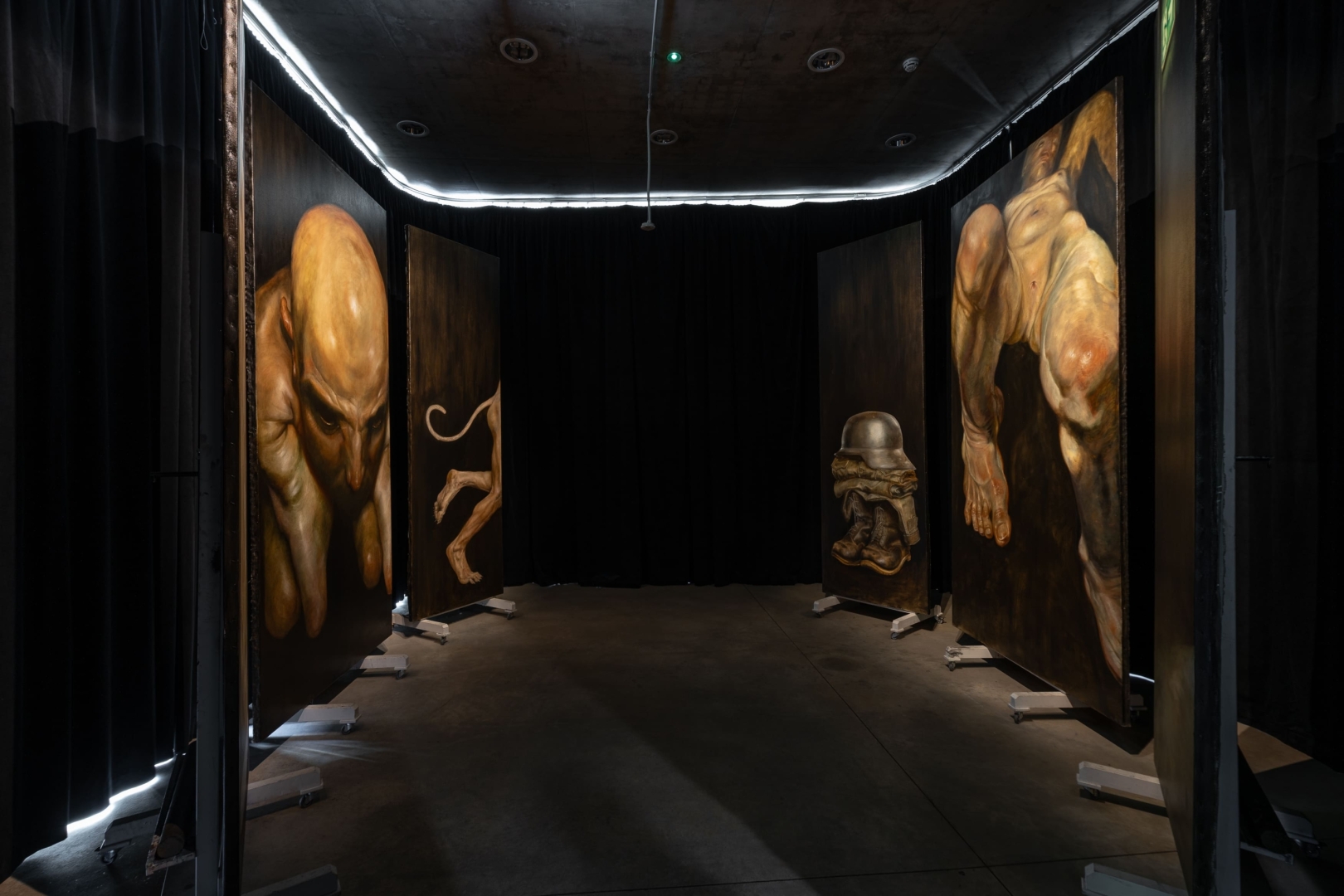
Additional photos


The Hollow Men, 2026
Oil on canvas, six panels
Those who have crossed
With direct eyes, to death’s other Kingdom
Remember us – if at all – not as lost
Violent souls, but only
As the hollow men
The stuffed men.
-T.S. Eliot, The Hollow Men
Furthermore, we designed a mother-machine with maximal maintenance efficiency since failure of any system or function could be resolved by the simple substitution of black boxes and new component parts.
-H.F. Harlow, The Nature of Love
Every social order – family, state, gender, language, the body – tries to organise and stabilise life. These systems define what a body should do, what a subject should be, and how desire should circulate. The masculine image-body should express force, energy and direction. It should be a racehorse, a column, a gun. Images of idealised masculinity present themselves as the most natural: power is concentrated in those deserving, in bodies fit to rule, created to govern and discipline. This closed system is dependent on a membrane (a uniform, the cloth mother) that fixes selves and categories, protecting the subject from the burden of actually existing. I want to pierce that membrane, to plot a line of flight from categories and selves.
You may also like these